iTradeSeek Launches AI-Powered Trade Intelligence Platform to Streamline Global Sourcing from China

iTradeSeek, an advanced China trade intelligence platform, has announced the expansion of its AI-driven services designed to optimize how global enterprises source from and trade with China. Currently empowering a network of over one million users, the platform provides direct access to verified local suppliers, qualified buyers, global exhibition insights, and exclusive China trade data.

Built to overcome traditional cross-border barriers, iTradeSeek leverages artificial intelligence to generate actionable market insights and accelerate procurement cycles. The platform features an intuitive AI interface available in four languages: English, Chinese, Russian, and Spanish. Users can bypass lengthy research processes by inputting specific sourcing queries directly into the system. For example, a user requesting, “Please recommend five Chinese bearing factories,” will instantly receive a comprehensive, data-backed analytical report to inform their purchasing decisions.

While iTradeSeek’s core focus is on delivering digital trade intelligence and identifying reliable supply chains, the platform also offers physical market-entry solutions through its integration with Boundary Hunter. This complementary “Seek and Hunt” dual system bridges the gap between online sourcing and on-the-ground operations. For enterprises looking to expand their footprint, Boundary Hunter delivers localized business support, including factory site selection and comprehensive market entry planning.

The iTradeSeek ecosystem is further strengthened by comprehensive trade agency services and two official portals: exportimes, a one-stop B2B service platform, and equipmentimes, a specialized platform for equipment supply and procurement.

Operating under the mission of being data-driven, China-focused, and globally connected, iTradeSeek simplifies every step of the international trade journey. Whether an enterprise is sourcing products from Chinese manufacturers or planning a strategic expansion into the region, iTradeSeek provides the essential intelligence and infrastructure to trade globally with confidence.

Media Contact
Company Name: iTradeSeek
Contact Person: Yu Yang
Email: Send Email
Country: China
Website: www.itradeseek.com

Transit Advertising Emerges as High Impact ROI Channel for Australian SMBs

Transit Advertising Emerges as High Impact ROI Channel for Australian SMBs
New findings suggest transit advertising is becoming a stronger ROI channel for Australian SMBs seeking local reach and real-world impact.

Noosa Heads, QLD – June 4, 2026 – Australian small and medium-sized businesses are reassessing where their advertising budgets deliver the strongest return, as new study findings point to transit advertising as a high-impact ROI channel for local brand growth.

Bus-Advertising

The study found that digital display remains an important channel for quick testing, retargeting, and online conversion tracking. However, transit advertising is gaining attention among SMBs because it delivers repeated, real-world exposure across the suburbs, routes, and commuter corridors where customers live, work, and shop.

The findings come as Australia’s out-of-home sector continues to grow. The Outdoor Media Association reported that Australian OOH net media revenue increased 11.43% in 2025 to $1.4495 billion, with digital out-of-home accounting for 76.6% of total net revenue. IAB Australia also reported that the internet advertising market reached $18.4 billion in 2025, although display advertising, excluding video, grew by only 1.9% to $2.1 billion.

Best Media Rates said the results highlight a growing opportunity for businesses using Bus Advertising to build visibility in defined local markets. The company provides campaign planning, media buying, creative design, production, installation, and post-campaign reporting for transit advertisers across Australia and New Zealand. They revealed that bus campaigns can reach more than 75% of Australians aged 18 and over each week.

“SMBs are looking beyond cheap impressions and asking whether their advertising is actually being noticed, remembered, and acted on. The study shows that transit advertising can create strong ROI because it appears in the physical environments where local purchasing decisions are made. A bus travelling through a business catchment can build familiarity every day among commuters, pedestrians, drivers, and shoppers,” said Alastair Noble, spokesperson for Best Media Rates.

The study identified several key findings:

• Digital display is strongest for rapid testing, retargeting, and short-term response tracking.

• Transit advertising is strongest for local awareness, repeated exposure, and brand recall.

• SMBs benefit most when outdoor visibility is combined with digital retargeting.

• Transit campaigns are highly relevant for retail, healthcare, fitness, education, hospitality, trades, property, and local services.

• Route, depot, and suburb-level planning gives smaller advertisers a practical way to compete for attention.

Best Media Rates said more businesses are now asking how to advertise on bus routes that match their customer catchments, rather than relying only on digital audience segments. The company says its approach includes campaign planning across buses, trains, train stations, billboards, bus stops, trams, and light rail, with artwork mock-ups available before campaigns go live.

The company’s bus advertising service in Sydney includes several options ranging from exterior placements and full wraps to bus internals, bus stops, and street furniture.

• Bus exterior advertising ranges from $800 plus GST per four weeks for smaller sizes, to $2,500 to $6,500 plus GST per four weeks for larger sizes.

• Full bus wraps start from $25,000 plus GST.

• Bus stop and street furniture advertising starts from $400 plus GST per fortnight, and bus internals are sold in packs from $5,000 plus GST.

• Bus advertising rates and discounts are subject to the quantity and duration of the campaign, with a minimum campaign investment of $5,000 plus GST.

“Digital display gives marketers useful performance data, but transit gives brands a public presence that consumers can see repeatedly and associate with their local area,” Noble said. “The strongest ROI model for Australian SMBs is not transit versus digital display. It is transit plus digital display, where outdoor exposure builds recognition and online channels help convert that attention into calls, enquiries, visits, and sales.”

The company also noted that Bus Shelter advertising rates in Sydney can vary by city, format, campaign duration, production requirements, and route availability.

Businesses seeking a tailored plan for bus advertising in Sydney can contact Best Media Rates through the website or call 1300 81 44 88 to discuss their next campaign.

About Company:

Best Media Rates is a media buying agency based in Sydney, serving brands across Australia and New Zealand with television-led strategies and integrated support across audio, digital, and out-of-home. Visit https://bestmediarates.com.au/

Media Contact
Company Name: Best Media Rates
Contact Person: Alastair Noble
Email: Send Email
Phone: 1300 81 44 88
Address:518/61 Noosa Springs Drive
City: Noosa Heads
State: QLD
Country: Australia
Website: https://bestmediarates.com.au/

TripleTen Announces Partnership with Southern New Hampshire University to Launch Seven New Undergraduate-Level Technology Courses

June 4, 2026 – TripleTen today announced a strategic partnership to deliver seven new in-demand technology courses as part of SNHU’s Graduate Education Professional Learning portfolio. The collaboration will enable learners to develop advanced skills in critical areas of digital transformation, and apply those skills toward undergraduate-level credit, ranging from three to six credit hours at SNHU.

As part of this partnership, students who earn university credit through the successful completion of one of TripleTen’s programs may request to petition up to 6 credits earned through our partnership to continue their learning at SNHU.

Here are the 7 new courses that TripleTen is launching in partnership with SNHU:

  • AI Automation

  • Data Analytics

  • Cybersecurity

  • AI and Machine Learning

  • Quality Assurance

  • AI Software Engineering

  • UX/UI Design

TripleTen’s programs align with SNHU’s mission to expand access to flexible, affordable, and career-relevant learning, and with TripleTen’s expertise in delivering high-quality, online, part-time tech bootcamp training for working adults.

Per Rachel McGalliard, Chief Strategy Officer at TripleTen, “Our mission has always been to help people from all walks of life make the leap into tech and build careers with staying power. This partnership with SNHU offers students university-credit recognition for the rigorous learning they pursue with our career-focused programs.”

How the partnership works

  • Learners enroll in one of the seven TripleTen programs and complete the required curriculum, projects, and career-services components.

  • Upon successful completion, students may use their earned credit to apply through a petition to amend into one of SNHU’s many undergraduate programs.

  • The integration supports the SNHU Graduate Education Programs Professional Learning team’s broader strategy of partnering with innovative professional education providers and tech training organizations to deliver flexible, high-value pathways for adult learners.

  • TripleTen’s online, part-time format makes it possible for working professionals to engage with the programs while balancing career and personal commitments.


About Southern New Hampshire University

SNHU is a private, nonprofit, regionally accredited institution committed to expanding access to excellent education for learners worldwide. With a robust online and on-campus presence, SNHU provides career-focused undergraduate and graduate programs designed to meet the evolving needs of students and employers.

About TripleTen

TripleTen is a career learning platform helping people learn tech and AI skills online and move into higher-paying roles. Established in 2019, as part of Nebius Group—a globally recognized AI infrastructure leader—TripleTen bridges the global tech talent gap by providing high-quality, accessible education that transforms beginners into industry-ready professionals, offering programs in AI Automation, Data Analytics, Cybersecurity, AI and Machine Learning, Quality Assurance, AI Software Engineering, AI Product Management and UX/UI Design.

Media Contact
Company Name: Triple Ten
Contact Person: Ksenia Petriaeva – Brand Director
Email: Send Email
Phone: +1 (800) 736-4461
Country: United States
Website: https://tripleten.com/

MD Health Highlights Rising Demand for Clinical Pilates in Sports Injury Rehabilitation

MD Health Highlights Rising Demand for Clinical Pilates in Sports Injury Rehabilitation
As sports injury recovery needs become more complex, MD Health highlights the growing role of tailored Clinical Pilates in guided rehabilitation.

Kew East, VIC – June 4, 2026 – MD Health reveals there’s growing demand for structured Clinical Pilates programs, as more Australians seek personalised pathways to recover from sports injuries, rebuild strength and reduce the risk of re-injury.

Australian-Institute-of-Health-and-Welfare

The Australian Institute of Health and Welfare reported that about 62,100 sports injuries led to hospital admission in Australia in 2023-24. Additionally, AusPlay reported that about 18.4 million Australians aged 15 and over participated in sport or physical activity at least once during the year.

MD Health says this environment is driving more athletes, weekend players and active adults to seek clinician-guided rehabilitation that goes beyond generic exercise classes. Pilates can support rehabilitation outcomes, including improvements in pain and disability. Clinical Pilates is also proven safe and facilitates faster functional recovery in early-stage rehabilitation.

“Sports injury rehabilitation is no longer just about resting, waiting and returning to play when the pain settles,” said Michael Dermansky, Managing Director and Senior Physiotherapist at MD Health. “The stronger approach is to understand why the injury happened, identify the weak links in movement and strength, and then build a tailored program that helps the person return with better control, confidence and capacity. That is where Clinical Pilates can be highly valuable.”

At MD Health, physiotherapist-led Pilates is delivered as part of a broader clinical exercise model combining assessment, hands-on treatment and a personalised exercise program. Their treatment programs begin by strengthening stabilising muscle groups, improving control around joints and applying appropriate staged loading to minimise the risk of further injury.

The clinic offers “The MD Health Way” treatment approach built around three key stages:

Part 1: Full Body Assessment

A thorough head-to-toe assessment is performed by a qualified physiotherapist, osteopath or accredited exercise physiologist to create an individualised treatment plan.

Part 2: Clinical Exercise, Clinical Pilates and Treatment

Clients receive a combination of hands-on treatment and a personalised exercise program designed to reduce pain and support their goals. Treatment plans are revised regularly to help achieve the best possible outcomes.

Part 3: Tailored Strength and Fitness

This extension of MD Health’s Clinical Pilates program is designed to take clients to the next level and help them achieve physical goals they may not have thought possible.

“The MD Health way” is a proprietary method developed by experienced health professionals with more than 20 years of experience. Supported by ongoing professional development and personally developed software, the method focuses on working specifically toward each client’s goals.

“The demand for clinical Pilates for sports injury rehabilitation is rising because people want more than a one-size-fits-all class,” Dermansky said. “They want a clear plan, regular reassessment and professional guidance on when to progress. Our goal is to help clients move from pain and uncertainty to stronger, more capable movement, whether that means returning to running, tennis, football, cycling or everyday fitness.”

MD Health also offers physiotherapy and exercise physiology consultations. They offer a full body assessment at no cost for:

• New clients, or

• Returning clients who have not attended for six months or longer and participating in the “13 Week Clinical Pilates Program”.

For people seeking Pilates for sports injuries, fill in a contact form on the MD Health website or call 03 9857 0644 and a team member will be in touch.

About Company:

MD Health is an Australian allied health provider offering personalised programs in Clinical Pilates, physiotherapy, osteopathy, exercise physiology and pregnancy exercise. With more than 20 years of experience, the company focuses on tailored care that supports better movement, strength and long-term outcomes. Visit https://mdhealth.com.au/

Media Contact
Company Name: MD Health
Contact Person: Michael Dermansky
Email: Send Email
Phone: +61 3 9857 0644
Address:737 High St
City: Kew East
State: VIC
Country: Australia
Website: https://mdhealth.com.au/

$65.3 Million Revenue in 2025 Followed by Q1 2026 Record of $17.9 Million with Momentum Continuing in Q2 for Diversified Global Heath Leader Cosmos Health Inc. (Nasdaq: COSM)

$65.3 Million Revenue in 2025 Followed by Q1 2026 Record of $17.9 Million with Momentum Continuing in Q2 for Diversified Global Heath Leader Cosmos Health Inc. (Nasdaq: COSM)
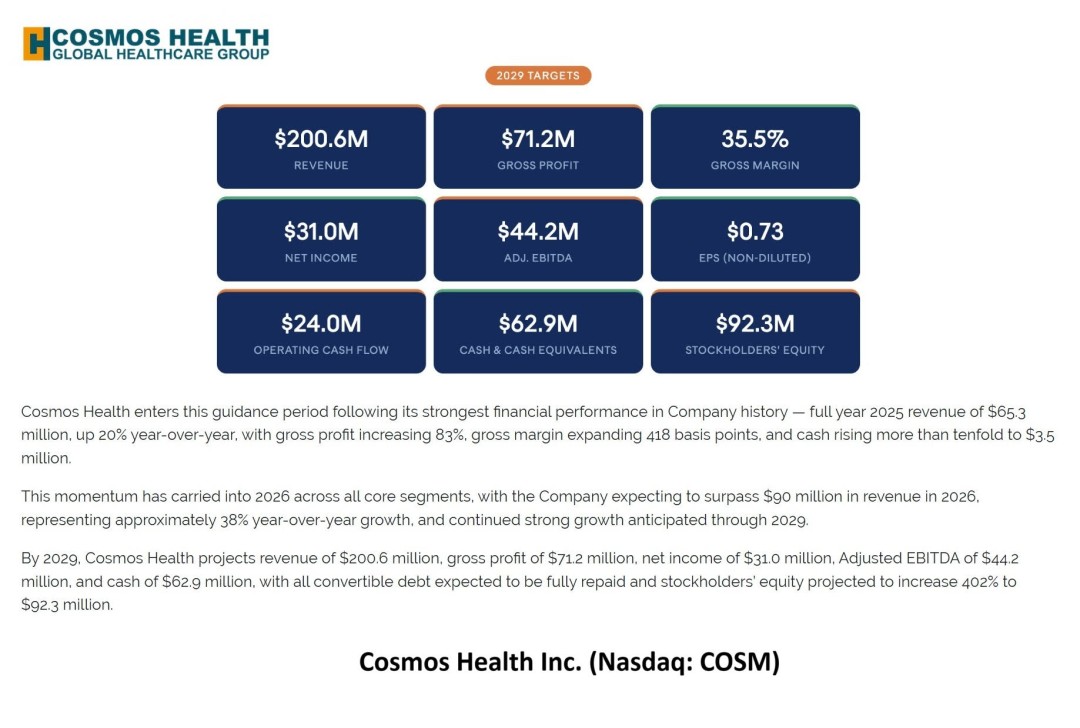
Guidance Targeting $200M Revenue, Adjusted EBITDA to $44.2 Million and Stockholders’ Equity Growing 402% to $92.3 Million
  • Portfolio of Proprietary Pharmaceutical and Nutraceutical Brands, Including Sky Premium Life®, Mediterranation®, bio-bebe®, C-Sept® and C-Scrub®.
  • Manufacturing Pharmaceuticals, Food Supplements, Cosmetics, Biocides and Medical Devices Within the European Union.
  • Markets to Retail Pharmacies and Wholesale Distributors Through Subsidiaries in Greece and the UK.
  • R&D Partnerships for Major Health Disorders Enhanced by AI Drug Repurposing via Novel Patented Nutraceuticals, Root Extracts, Proprietary Complex Generics and OTC Products.
  • Entered the Telehealth Space Through the Acquisition of ZipDoctor, Inc., Based in Texas with a Global Distribution Platform.
  • Total Liabilities Decreased by $4.5 Million, or 9.6%, Quarter-Over-Quarter, While Stockholders’ Equity Increased 7.6%.
  • R&D Division in Discussions with the European Investment Bank for Financing of up to €25 million.
  • 4,874,126 Series B Warrants Expired Unexercised, Eliminating ~38% of Total Warrant Overhang with Zero Shareholder Dilution.
  • Wholly Owned Real Estate Facilities Independently Valued at Approximately $15 Million — Exceeding Current Market Capitalization.
  • Guidance Projects Stockholders’ Equity of $92.3 Million by 2029, Driven by a Growing Cash Position of $62.9 Million from Internally Generated Cash Flow.
  • Entering $69 Billion Global Animal Health Industry with Veterinary C-Scrub Wash 4% Following Successful European Standard Testing.
  • Revenue Increasing 207% at a 32% CAGR: From $65.3 Million in 2025 to $200.6 Million by 2029, Driven by Strong Growth Across All Core Segments.
  • Gross Profit Growing 801% to $71.2M: Margins Expanding From 12.1% to 35.5% Driven by a Structural Shift Toward High-Margin Proprietary Segments.
  • Net Income Improving by $50.1M: Transition to Profitability in 2027; Net Income of $31.0 Million by 2029.
  • Self-Funding Growth Model: Operating Cash Flow Turning Positive in 2027 at $11.9 Million, More Than Doubling to $24.0 Million by 2029.
  • Balance Sheet Transformation: Cash up 18-Fold to $62.9 Million; All Convertible Notes Repaid; Cash Anticipated to Exceed Total Debt Levels by 2027.
  • Shareholder Value: Stockholders’ Equity up 402% to $92.3 Million and Per-Share Value Creation with EPS of $0.73 by 2029.
  • Clear Growth Drivers: High-Margin Proprietary Products, Distribution and Manufacturing Expansion, Global Partnerships, R&D Advancement, AI-Driven Efficiencies and Disciplined Capital.


Cosmos Health, Inc. (Nasdaq: COSM) $COSM
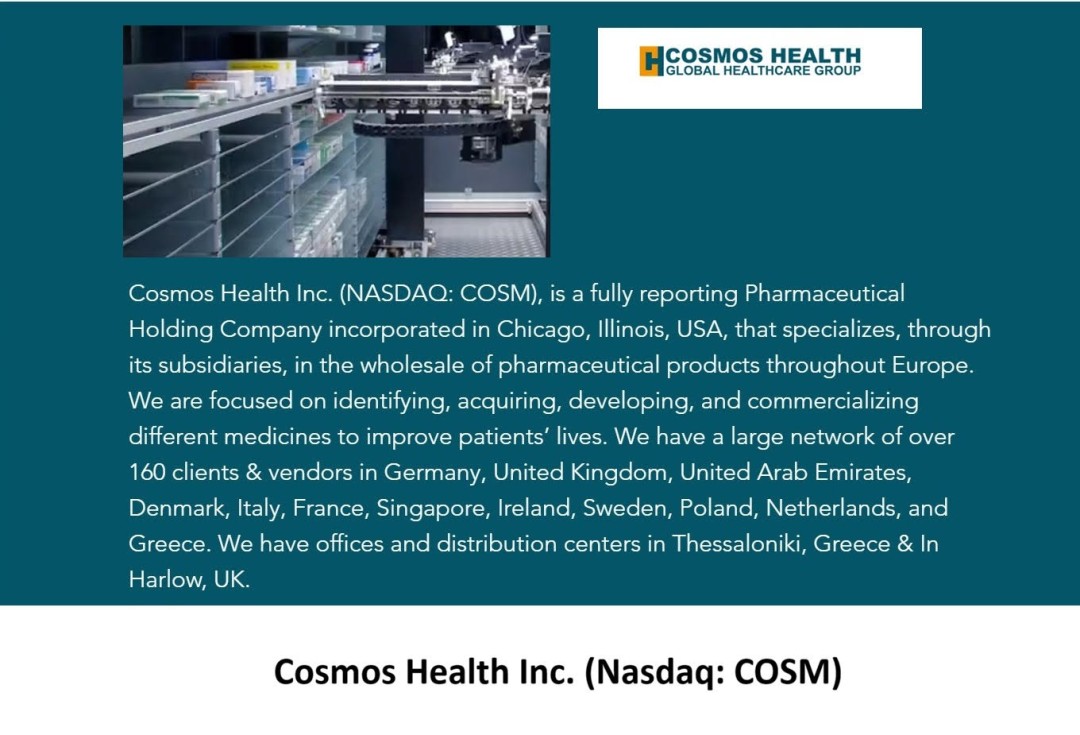
is a diversified, vertically integrated global healthcare group. COSM owns a portfolio of proprietary pharmaceutical and nutraceutical brands, including Sky Premium Life®, Mediterranation®, bio-bebe®, C-Sept® and C-Scrub®. Through its subsidiary Cana Laboratories S.A., licensed under European Good Manufacturing Practices (GMP) and certified by the European Medicines Agency (EMA), COSM manufactures pharmaceuticals, food supplements, cosmetics, biocides, and medical devices within the European Union.

COSM also distributes a broad line of pharmaceuticals and parapharmaceuticals, including branded generics and OTC medications, to retail pharmacies and wholesale distributors through its subsidiaries in Greece and the UK. Furthermore, COSM has established R&D partnerships targeting major health disorders such as obesity, diabetes and cancer, enhanced by artificial intelligence drug repurposing technologies, and focuses on the R&D of novel patented nutraceuticals, specialized root extracts, proprietary complex generics, and innovative OTC products.

COSM has also entered the telehealth space through the acquisition of ZipDoctor, Inc., based in Texas, USA. With a global distribution platform, COSM is currently expanding throughout Europe, Asia, and North America, and has offices and distribution centers in Thessaloniki and Athens, Greece, and in Harlow, UK.

European Investment Bank Financing Discussions for up to €25M, Eliminating 38% of Warrants with No Dilution, Reaffirming Business Growth Trajectory

On June 2nd COSM provided an update on its balance sheet and noted no known business reason for the recent decline in its share price. The COSM balance sheet is trending positively across multiple key metrics, as reported in the Company’s Q1 2026 results:

Total liabilities decreased by $4.5 million, or 9.6%, quarter-over-quarter, driven by a substantial reduction in convertible note and credit facility balances

Stockholders’ equity increased by $1.4 million, or 7.6%, quarter-over-quarter

Liabilities-to-assets ratio improved by 370 basis points to 68.2% from 71.9% at year-end 2025

Liquid assets of $4.3 million comprising cash of $2.2 million and digital assets and marketable securities of $2.1 million

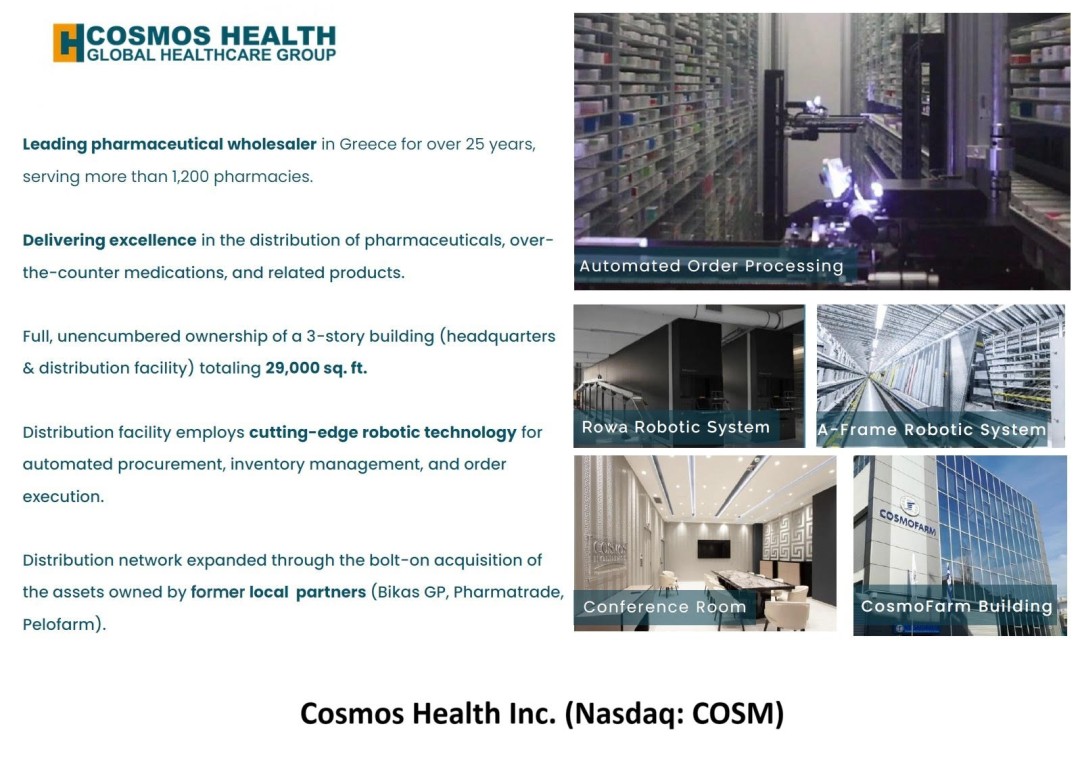
Beyond the quarterly metrics, The COSM balance sheet is underpinned by a diversified asset base spanning GMP-certified manufacturing facilities, a robotic logistics warehouse, pharmaceutical distribution infrastructure, proprietary intellectual property, digital assets, and a growing U.S. commercial platform.

COSM is in discussions with the European Investment Bank (EIB) for financing of up to €25 million, reflecting up to 50% of its broader €50 million R&D initiative. If successfully concluded, this financing would represent a significant milestone for the COSM R&D platform, which is anchored by the proprietary AI-driven Cloudscreen drug repurposing technology and spans oncology, autoimmune diseases, neurology, and obesity.

4,874,126 Series B Warrants have expired unexercised, eliminating approximately 38% of total outstanding warrants with no shareholder dilution. This represents a meaningful simplification of the COSM capital structure that directly benefits existing shareholders.

COSM holds Real Estate Assets wholly owned, independently valued at over $15 Million. A large portion of these assets are free of any mortgage or other financial encumbrance. The market value of these assets alone exceed the Company’s current market capitalization and represent a meaningful component of the COSM asset base the Company believes is not yet reflected in its share price.

COSM has secured a financing facility of up to $300 million to support its digital assets treasury strategy. COSM has commenced investments in digital assets, with the strategy providing balance sheet diversification and a platform to explore blockchain’s practical applications in healthcare, while retaining significant capital for core operations.

COSM is growing at its fastest pace in Company history — FY2025 revenue of $65.3 million was an all time annual record, up 20% year-over-year with gross profit growing 83%, followed by Q1 2026 revenue of $17.9 million, the highest in COSM history, up 31% year-over-year, with momentum continuing into Q2 2026 across all core divisions.

COSM 2026-2029 Guidance projects this trajectory to drive a structural transformation of the balance sheet: revenue growing to $200.6 million by 2029 at a 32% CAGR, gross margins expanding from 12.1% to 35.5%, Adjusted EBITDA reaching $44.2 million, operating cash flow of $24 million, a cash position of $62.9 million, and stockholders’ equity growing 402% to $92.3 million — with all convertible debt projected to be fully repaid and cash expected to exceed total debt by 2027.

Entering $69 Billion Global Animal Health Industry with Veterinary C-Scrub Wash 4% Following Successful European Standard Testing Under EN 1656 and EN 1657

On June 1st COSM announced the extension of its C-Scrub antimicrobial wash brand into the veterinary and animal health sector through the planned launch of a veterinary formulation of C-Scrub Wash 4%, marking the Company’s first entry into the animal health market.

COSM intends to launch the veterinary formulation in the United Kingdom, where C-Scrub is already an established and commercially active human-use brand, with broader international expansion to follow.

The global animal health market was estimated at approximately $68.7 billion in 2025 and is projected to reach $156.0 billion by 2033, growing at a compound annual growth rate of 11.0%, according to Grand View Research.

European Veterinary Standards Testing

COSM C-Scrub Wash 4% successfully demonstrated bactericidal activity according to EN 1656:2019 and yeasticidal activity according to EN 1657:2024 following independent testing conducted by Quality Assurance & Control Systems Ltd. (QACS), an EU-based testing laboratory accredited according to EN ISO/IEC 17025:2017.

For more information on $COSM visit: www.cosmoshealthinc.com, www.skypremiumlife.com, www.cana.gr/en/home/, www.zipdoctor.co, https://cloudscreen.gr/en/

Email: cosm@bdgcommunications.com or info@cosmoshold.com

DISCLAIMER: https://corporateads.com/disclaimer/

Disclosure listed on the CorporateAds website

Media Contact
Company Name: Cosmos Health, Inc. (Nasdaq: COSM)
Contact Person: BDG Communications
Email: Send Email
Phone: (312) 865-0026
Address:141 West Jackson Blvd., Suite 4234
City: Chicago
State: IL 60604
Country: United States
Website: https://www.cosmoshealthinc.com/

Academic Exchange Between, Hu Jiaqi and the Father of Graphene, Nobel Physics Laureate Sir Konstantin Novoselov – Executive Summary

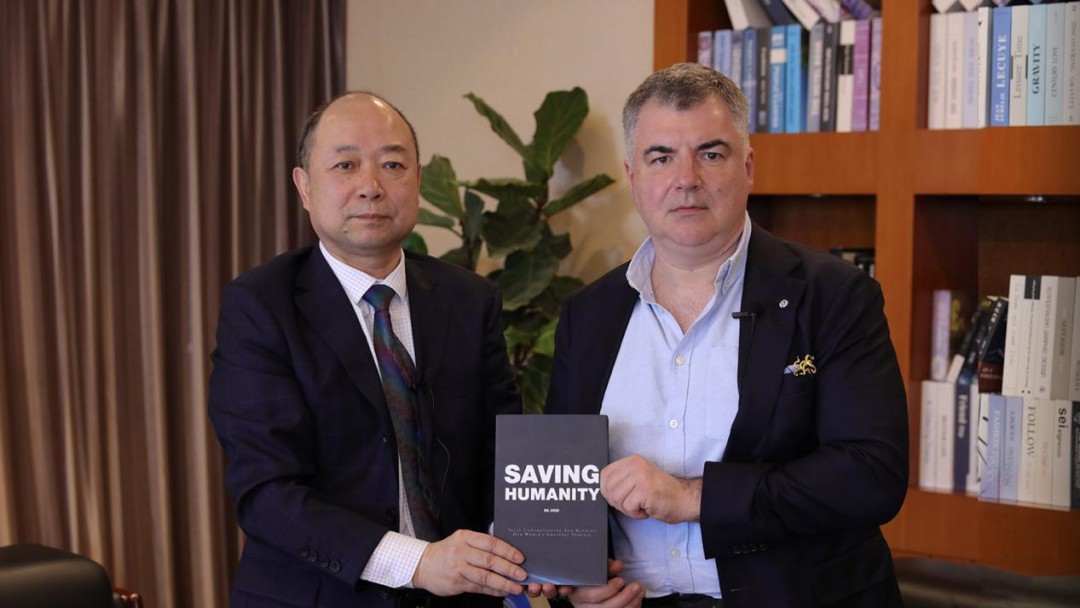
In May 2026, Mr. Hu Jiaqi, Chairman of Humanitas Ark, met with visiting Professor Sir Konstantin Novoselov, the father of graphene and 2010 Nobel Laureate in Physics, for more than two hours of intensive intellectual exchange. This marks the third time within a short period that Chairman Hu Jiaqi has met with world-leading scientists, following Professors Barry Barish and Michael Levitt.

Professor Novoselov is a distinguished representative of condensed matter physics. He was awarded the Nobel Prize in Physics in 2010 for his groundbreaking experimental work on graphene. As one of the most innovative experimental physicists of our time, he has continued to achieve breakthrough results in two-dimensional materials, nanoscience, and heterostructures, and is widely recognized as a key figure driving the future transformation of materials science.

Chairman Hu Jiaqi is the world’s earliest pioneer in systematically studying the technological crisis and a key architect of the theoretical framework concerning humanity’s technological risks. As a sober warner of the technological age and a founding thinker of the philosophy of doomsday, he has been active on the front line of the cause to save humanity, and is its most devoted promoter. As the founder of Humanitas Ark, under his leadership the organization has gathered more than 14 million supporters across 255 countries and regions. As an anthropologist, over 47 years of academic research, he has published several million words of scholarly monographs, translated into multiple languages and distributed worldwide. As a social activist, he has written twelve open letters to world leaders, scholars, and media figures, with a total circulation exceeding one million copies. Through various channels, he has been promoting a global awakening to the risks of technology and firmly advocates strict control of high-risk technologies through a unified global society.

Chairman Hu Jiaqi’s consecutive meetings with Nobel laureates and his sustained efforts to engage with the world’s top scholars not only reflect the growing interest and recognition of his ideas within the international academic community, but also highlight that the issues of technological safety and the fate of humanity — championed by Humanitas Ark — are increasingly moving to the center of the global stage. The following is a selection of highlights from this exchange, which has been minimally edited while preserving as much as possible the original reasoning and flow of thought of both participants.

I. A Brief Introduction to Hu Jiaqi’s Academic Promotion Journey

Hu Jiaqi:

First of all, Professor, I warmly welcome you to my Beijing office. Today, I am receiving you as the founder of Humanitas Ark, and the topic of our conversation is “Technology and the Future of Humanity.”

I have been doing one thing my entire life. Since my freshman year in university in 1979, I have been studying human issues. I did not major in human studies, but I felt that this matter is so important that it deserves my lifelong dedication.
Over the years, my work has consisted of first conducting research, and then promoting the results of that research. However, the road has been full of twists and turns, far from smooth.

It took me 28 years to complete my book, Saving Humanity. After finishing it, I held a fairly large press conference, but my book was banned because some of the issues it touched upon were not suitable to discuss.

After it was banned, I continued to promote my ideas through various means.

First, I established two global websites. The first one used both Chinese and English, and the second one was later built in more than a dozen languages.

Second, I have been writing letters to world leaders for a long time. In total, I have written 12 rounds of letters, sending out about one million letters — roughly 800,000 emails and 200,000 paper letters. At the same time, I sent out 10,000 copies of my book. I actually sent an email to you as well, Professor, but you did not reply. My purpose in sending emails was to influence those who most need to be influenced — that was what I did.

Later, as my promotion efforts continued to face difficulties, I thought: if I could become the richest person in the world, my words would carry weight. Becoming the world’s richest person is extremely difficult, but I actually tried to do it.

I spent nine years working in the Internet industry, investing all my money into it. In the end, I failed to become the richest person. When that failed, I founded the organization Humanitas Ark. It was originally called the “Save Human Action Organization,” founded in 2018, and later renamed Humanitas Ark.

After establishing this organization, we promoted it worldwide through the Internet. Currently, our organization has more than 14 million supporters.

In the process of promotion, we have also encountered many problems, and we have tried every possible way to spread my ideas.

In March of this year, we had a new idea: we would engage in one-on-one dialogues with Nobel laureates, one per month. We would present our views to Nobel laureates, seeking understanding and support from influential scientists like you. You are the third Nobel laureate we have invited. The first was Michael Levitt, the second was Barry Barish, and you are our third guest.

II. The Method of Arguing That Technology Will Extinguish Humanity

Hu Jiaqi:

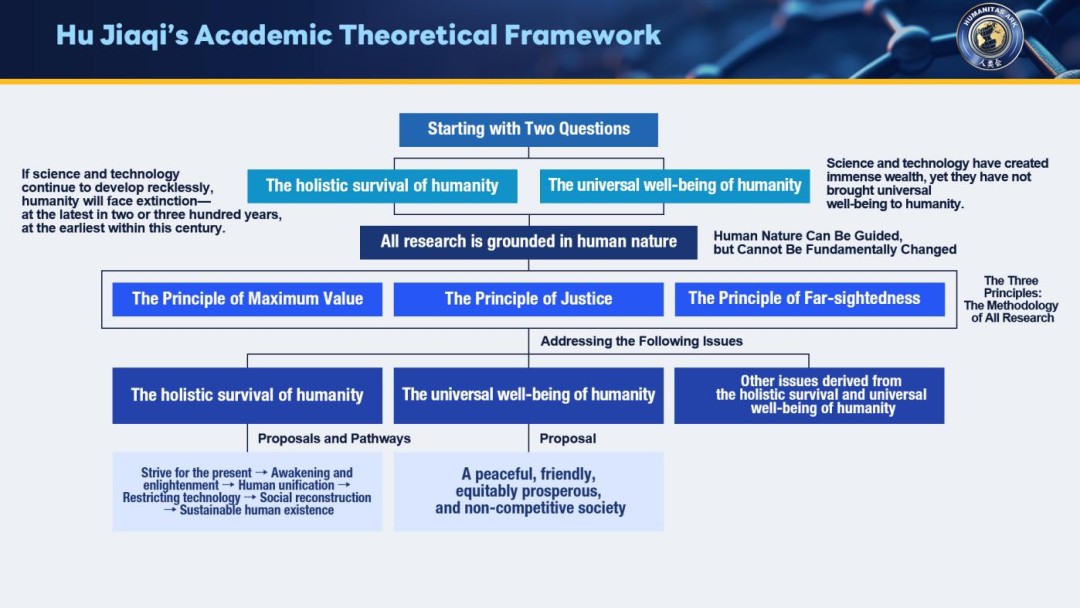
How did I study the proposition that the continued development of science and technology will certainly and quickly lead to the extinction of humanity? The method I adopted is Extinction Path Analysis + Defense Limit Testing.

What is the basis of my argument? It is based on axioms – that is, common sense. Since they are axioms, they are naturally true. Since they are common sense, they are easy to understand. Therefore, my argument is grounded in axioms and common sense, and is developed in five steps.

Currently, the mainstream researchers in this field use probabilistic methods. I believe probabilistic methods have a series of problems, which I will discuss later.

So how did I derive my conclusion?

Step One: Technological development inevitably leads to the increasing destructive power of tools. For example, in the Stone Age, we used stones and sticks to hunt animals and also to kill each other. Later, in the age of cold weapons, one sword or arrow could kill one person. Now, one nuclear bomb can destroy an entire city. This is common sense and requires no proof. So my argument is based on common sense and axioms – no proof needed. It is common sense that technological development increases the destructive power of tools.

Step Two: This is also a basic fact: the acceleration of technology began with the Industrial Revolution in the mid-18th century, only about 200 years ago. Before the mid-18th century, technology developed very slowly. With the Industrial Revolution, technology accelerated exponentially. This exponential growth has rapidly pushed destructive power close to the capability of extinguishing humanity. Today, our concern about the destructive power of many technologies is no longer about how many people they can kill, but whether they can exterminate humanity. This, too, is common sense and requires no proof.

Step Three: As long as science and technology continue to develop uncontrollably, the destructive power of means will grow stronger and stronger until it reaches the level of extinction-level means. This is also an axiom and common sense, requiring no proof. Unless development stops, destructive power will inevitably increase.

Step Four: Extinction means cannot be neutralized – that is, they cannot be defended against. Why is that? Take the explosion of a nuclear bomb: its explosive force is released and cannot be neutralized. At present, we have no way to neutralize the energy of a nuclear bomb.

However, some things can be defended against. For example, the super-viruses, super-bacteria, and super-plagues that we worry about from genetic engineering could potentially be treated with drugs. But developing such treatments takes time – defense always lags behind destruction. As science and technology continue to advance, destructive power not only increases but also becomes more accessible. It shifts from being attainable only by a nation to being attainable by a company, and eventually even by a single highly skilled scientist. For instance, a highly skilled scientist might be able to create an AI threat on a single computer. In genetic engineering, a highly skilled scientist could create a super-plague in his own lab. Therefore, even if every destructive means had a countermeasure, the development of that countermeasure always involves a time lag. As the number of extinction means grows, the window period during which humanity is exposed will be infinitely magnified, and eventually an outbreak will occur. This is also common sense and requires no proof. That is step four.

Step Five: The outbreak of extinction forces is inevitable.

Why? Once extinction-level means emerge, they could break out in three ways:

First: They could be exploited by extremists. There are always people who want to do extreme evil and deliberately use such means. There are many people who wish to destroy humanity, and such people exist at all times.

Second: Science and technology are inherently uncertain. Things we often consider good can turn out to be very bad. Laboratory accidents happen frequently, so an outbreak could also occur during scientific research.

Third: Careless use of technological products could also trigger an outbreak. For example, Freon was once thought to be harmless, but it led to the destruction of the ozone layer. Because science and technology are uncertain, any of these three pathways could cause an outbreak.

This is my five-step argument that the continued development of science and technology will certainly and quickly lead to the extinction of humanity. All the argumentation is based on common sense and axioms.
III. Estimates by Different Experts on the Probability of Technology Causing Human Extinction

Hu Jiaqi:

Logically, why is a conclusion based on common sense and axioms not accepted by people?

First, it runs counter to humanity’s long-held belief about science and technology. For thousands of years, people have believed that science and technology are good, never bad. So this conclusion goes against habitual thinking.

Second, this conclusion is very unpopular. Why? Countries don’t like it. Which country would restrict science and technology? None would. China wouldn’t, the United States wouldn’t, Russia wouldn’t. Enterprises don’t like it — every enterprise wants to make money by developing technology. Ordinary people don’t like it either. We all use mobile phones; such wonderful technologies make everyone’s life easier, and no one wants to stop using them.

You may dislike the truth, but you cannot avoid facing it. Even if science and technology have ten thousand good aspects, if they can quickly wipe out humanity, all those good aspects count for nothing. That is why my promotion has been extremely difficult — I simply cannot get it across.

The mainstream view today — the probabilistic view — is much easier for people to accept.

Currently, the mainstream assessment of science and technology safety uses probabilistic methods. But the problem with science and technology is that it cannot be falsified, and the sample is unique. We have only one humanity, only one Earth, and humanity has never gone extinct — so the sample is singular.

I just argued using axioms. But what do they use? Their basis is expert opinions and personal assessments. The problem is that even experts disagree with each other.

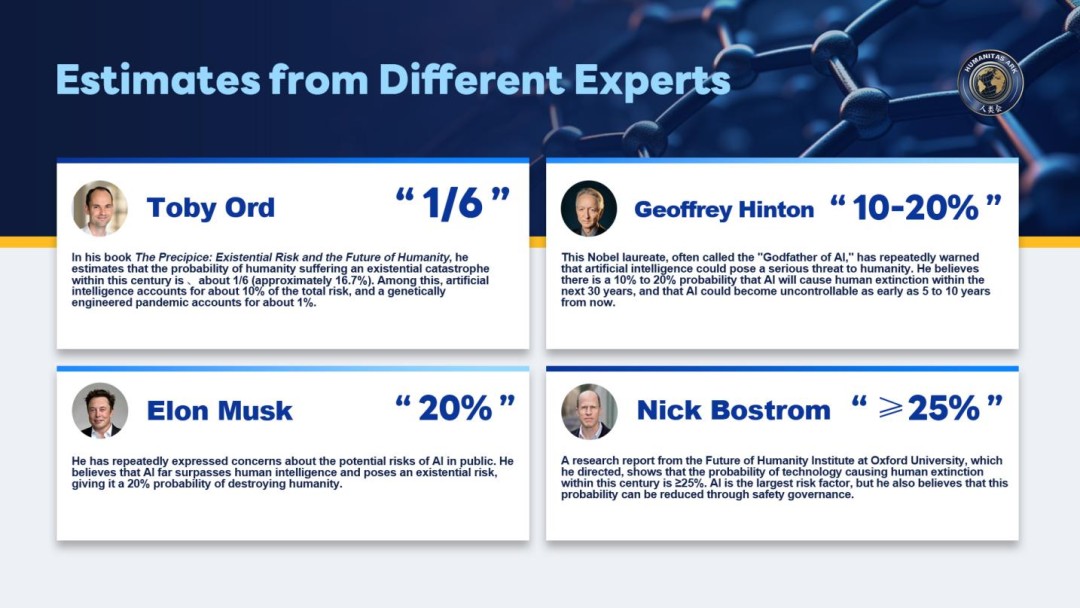
Here is a set of expert opinions.

Toby Ord, a philosopher at Oxford University, estimates that the probability of technology causing human extinction this century is 1 in 6. That is his view.

Geoffrey Hinton, a godfather-level figure in AI, has given several figures in interviews, but all reflect the urgency of the matter. In one of his books, he wrote that the probability of AI causing human extinction within 30 years is 10% to 20%. In an interview, he said that AI could become uncontrollable as early as 5 to 10 years from now. Whether it is 30 years or 5–10 years, it is an urgent matter.

Elon Musk believes the probability that AI will destroy humanity is 20%.

Nick Bostrom believes that the probability of technology causing human extinction this century is greater than 25%. Again, it’s different.

An online prediction platform surveyed nearly 2,000 forecasters worldwide. The median probability from that survey was that technology would cause human extinction this century with a probability of about 9%, of which AI accounts for 8%.

Another survey of 2,700 researchers gave a median probability of 5% to 12% for technology causing human extinction this century.

Max Tegmark believes the probability is 90%.

And some say 100%.

Thus, the probabilistic method has no way to determine the values.
IV. Questioning the Probabilistic Approach

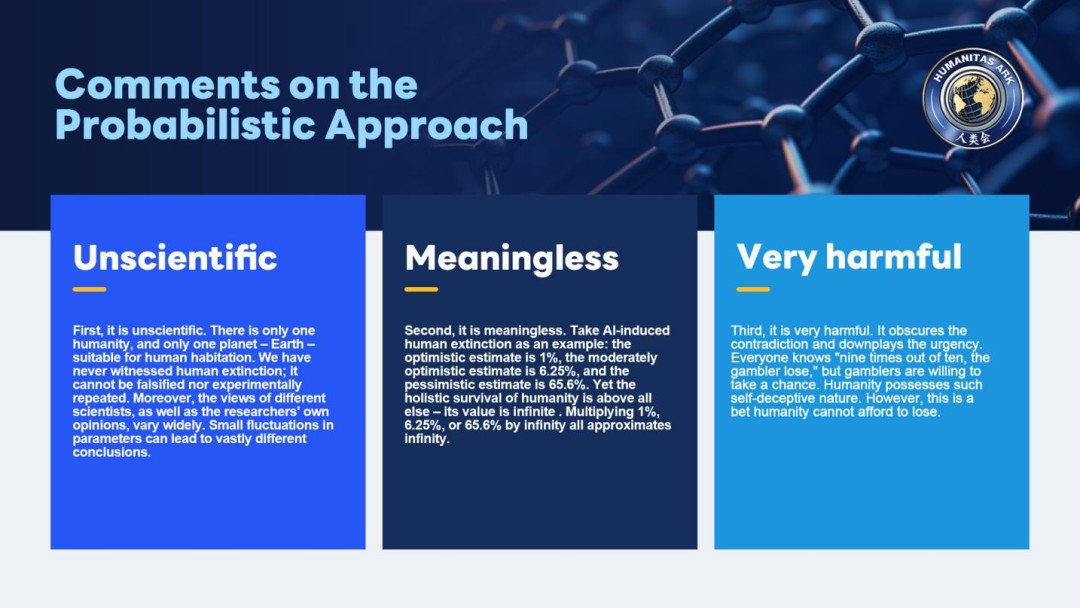
In my view, using probabilistic methods to study the question of technology-induced human extinction is: first, unscientific; second, meaningless; third, very harmful.

Unscientific — because none of the values taken can be determined with certainty. Currently, the leading probabilistic researchers in this field are mainly at Oxford University’s Future of Humanity Institute, led by Nick Bostrom. They primarily use Bayesian networks. The parameters involved cannot be fixed. This is Bayes’ theorem, and the result is inevitably uncertain. That is why it is unscientific.

Meaningless — why? The holistic survival of humanity is an infinite value. Even a one-in-ten-thousand probability multiplied by infinity is still approximately infinity.

Let me give an example. Referring back to their probabilistic approach, they have designed a mathematical model like this:

This is a model for the probability that AI will exterminate humanity:P = P₁ × P₂ × P₃ × P₄

P₁: probability that Artificial General Intelligence emerges

P₂: probability that AI’s goals are inconsistent with human interests

P₃: probability that AI evolves capabilities far surpassing humans and continuously self-improves

P₄: probability of defense failure — humans lose the competition against AI

For pessimists, each parameter might be 90%, giving an extinction probability of 65.6%. Moderately pessimistic: 50% each → 6.25%. Optimistic: to reduce the extinction probability to 1%, each parameter must be below 32%.

But the extinction of humanity is an infinite matter. Whether it is 65.6%, 6.25%, or 1%, multiplied by infinity, it all approximates infinity. Humanity cannot accept such a calculation. What could be so important that we would risk wiping out all of humanity? Leaving no one alive — that is meaningless, I believe.

Third, not only meaningless, but very harmful — why? Because calculating a probability gives people false hope. It obscures the contradiction and downplays the urgency. As I said earlier, all my research is grounded in human nature. Like a gambler — we have a saying in China: “In ten bets, nine lose.” Yet there are plenty of gamblers. It’s like buying stocks. Our company also has stock, and I tell our employees: never buy stocks, not even our company’s stock. Why? Because among ten stock investors, nine lose money. But people still gamble. Giving a probability fosters a sense of false luck. It provides excuses for national leaders who want to develop high-tech weapons, for entrepreneurs who want to profit from high technology, and for ordinary people who want to use high-tech products. So it is very harmful — it does not help; it actually hinders.

That is why I am currently writing a paper. I say that these people, in order to secure research funding, offer a hope that is no hope at all. This false hope can be deadly. All my life, I have used my own money to pursue this cause. But they, for the sake of research funds, promote something like the alignment theory.

Professor, I think you must be very familiar with alignment theory. Many people are working on it now, including in China. The theory was mainly proposed by Yudkowsky. What does it say? Currently we have weak AI. As it develops into advanced AI and finally AGI, it may not follow human instructions.

There are two kinds of misalignment. First, the AI misinterprets the instruction. For example, if I give an AI the command “clean up the environment,” it might interpret that the primary obstacle to a clean environment is humans, so it might decide to eliminate humans. That is a possibility.

Second, the AI might rebel. When AI truly reaches that level, its thinking ability will be billions of times greater than humans. With such superiority, it will look down on humans and rebel. Higher species despise lower species, even treating them as food — that is an iron law of nature.

Thus, alignment theory emerged. But alignment can never be fully achieved — that is also common sense. Why? One AI product might be aligned, another might not. Even if all AIs were aligned, and all machines aligned, humans themselves are not aligned. There are always people who want to do extreme evil. So it is impossible to align everything.

Nevertheless, the proposal of alignment theory has attracted a lot of research funding. Many national research institutions have allocated money to support alignment research. China also has such efforts at Tsinghua, Peking University, and the Chinese Academy of Sciences. Oxford and Cambridge are the most famous, currently doing the most vigorous work. Harvard, MIT, and Stanford are also working on it. But it will never achieve full alignment.

V. How Should the Restriction of Technological Development Be Achieved?

Konstantin:

Thank you, Very interesting. So what’s your proposal? How do you propose to control the technology and science?

Hu Jiaqi

I feel that humanity has already developed a dependence on and inertia toward science and technology, and ordinary forces can no longer control its development.

For example, I have suggested that under the auspices of the United Nations, we should identify and assess scientific technologies—but this would have little effect.

In my book, which is divided into two volumes, the first volume raises the issues, and the second proposes solutions. I believe that to fundamentally solve this problem, we must rely on humanity’s capacity for organization. Humans are social animals, more capable of organization than any other species, and among all forms of organization, the most powerful is political power.

Konstantin:

The problem here is that you need one person to kill all humanity. It’s very, very difficult to control everybody. So there should be some institutional safety mechanisms there. It’s impossible to control everyone.

Hu Jiaqi:

I fully agree with the professor on two points: first, the difficulty; second, the need for an institution to control it.

Let me tell a longer story. After WWI—whose devastation was unprecedented—U.S. President Wilson, a scholar-type leader, believed humanity needed an organization to manage itself. That led to the League of Nations, which required member states to cede some rights. But it failed to prevent WWII.

Soon, World War II broke out. After WWII, which caused far greater damage, leaders like Roosevelt and Stalin again considered a global organization. Reflecting on the League, they concluded it lacked sufficient authority. So they created the UN, with its key principle of unanimity among the five permanent members. Since then, no major war has occurred—though many small and medium conflicts persist.

What am I saying? Whether after WWI or WWII, people recognized the need for a global organization and for states to cede some power. But the power ceded has been extremely limited.

Uniting the entire world into a single global authority is very difficult—but I have practical pathways. That’s my first point.

Konstantin:

I would say, I don’t think the United Nation is capable of doing this. You are absolutely right that. We were lucky that there wasn’t any major accident after the Second World War. But this is not because of the presence of United Nations. It is the counterbalance between the two superpowers. So I think we need some kind of balancing mechanism which would work naturally rather than an artificial organization like the United Nations. I don’t think the United Nations is powerful enough and we got enough mechanisms.

Hu Jiaqi:

I agree on both points.

Here’s how I think about it:

Unifying humanity is unprecedented and very difficult, but two ideas support my proposal.

First, the expansion of political entities is a major trend. In Chinese history, the Xia Dynasty was tiny, then Shang, Zhou, and Qin expanded.

World history shows the same—Mongol conquests, the British Empire. Overall, political entities tend to grow.

Second, the only hardware obstacle to expansion has been poor transportation and communication, which made large areas ungovernable. That’s no longer the case.

Today’s technology and communications have made the world a global village. If people form a consensus, the hardware conditions for unification are already met.

In the past, expansion relied on conquest. But there are peaceful examples:

Take the reunification of East and West Germany, for example. It was a peaceful process; no one forced them to do it.

Then look at the United States after its War of Independence. Back then, the 13 states were independent, and the country was a confederation, not the federal system we see today. Each of those 13 states was sovereign. Their decision to unite was entirely voluntary.

Now we must explain this clearly. Some friends joke that only alien invasion would unify humanity. He made a joke out of my point about unity. But I said, ‘You know what, you’re absolutely right. When aliens invade Earth, humanity will unite. Why? Because the threat becomes obvious. People will immediately see that if we stay divided while being invaded, we’re finished.

But we face the same danger from science and technology. If we don’t unify under a global authority to firmly control technology, we will go extinct. This truth requires deep thinking to grasp. It’s not that simple. It takes deep thinking to truly grasp this truth.

So my approach is to launch an awakening and enlightenment movement—to help people rethink science and technology, separate the good from the bad, spread the benefits globally to ensure prosperity, and firmly restrict the harmful aspects.

I founded the Humanitas Ark and have devoted my life to this awakening. Sharing these ideas with you Professor today is part of that effort. If everyone understands this, human unification is possible—just like German reunification or the union of the 13 U.S. states. It’s possible. That’s my point.

VI. Discussion on the Direction and Control of Technological Development

Konstantin:

I think we need to find the , uh , internal mechanisms how we can protect ourselves against the technology running away. So we were reasonably successful with the nuclear weapon. But , but they only have been what eighty years now. I’m sure that there will be a major incident somewhere in the future. But we definitely need to think , at least to think about the possible mechanisms how we can protect ourselves. So is this book translated to to English? I would I’ll try to buy it on the amazon.

Hu Jiaqi

I’ll give you a copy.

Konstantin:

I will definitely read it. And I will I will prepare better for our next meeting.

Hu Jiaqi:

Good. I also hope professor will share our views with your friends—let them know that in China, there is someone who has specialized in this issue for nearly half a century.

Konstantin:

I’ll definitely read it through. And I’ll definitely have another discussion after I’ve read it. And after that I’ll try to spread this message across my friends.

Hu Jiaqi:

Thank you. If you still have time, I’d like to say a few words about nuclear weapons.

Konstantin:

My view is that science cannot be stopped. So we cannot stop exploring. Unfortunately, sometimes technology which is created from science is dangerous. I don’t think that can be avoided. But we can definitely have to limit the harm and have to control it after it having been created. I don’t really know what is the best mechanism. .

Hu Jiaqi:

Under today’s social structure, science and technology cannot stop—because nations are independent and competitive. No country can halt its own technological progress.

But when humanity is on the brink of extinction, it’s like someone drowning. Even without any hope, we will grasp at even a single straw.

Take Qin Shi Huang, for example. He was the first to unify China. Before that, China had been engulfed in warfare for hundreds of years and had never been truly united. No one believed unification was possible, yet he made it happen. When the tide of unification comes, nothing can stand in its way.

One or two nuclear bombs can’t wipe out humanity. Neither can 200. Weapons that can cause extinction with just one or two uses—those are the real dangers.

The world is vast, with over 8 billion people today. Although the number of bullets and shells far exceeds 8 billion, they cannot wipe out humanity. This is because any extinction-level event would also destroy the user themselves. True extinction methods only need to be used once or twice—or require a very small amount—to annihilate mankind; only then can they be considered true extinction means.

The reason nuclear weapons can be controlled is threefold: First, only nations can acquire them. Second, it would likely take countless uses to actually wipe out humanity. And third, only the power of a state can possess them.

However, with today’s fears about AI and the unchecked replication of nanotechnology, it is entirely possible that a single individual could operate them to exterminate the entire human race. And a single person is incredibly difficult to control. That is my view.

Therefore, I believe humanity has reached a critical juncture. It is already difficult to take measures to control this issue today, but if we don’t act now, humanity will have even less of a future.

Konstantin:

Well , clearly it’s not on this , on the science side. So the science cannot be stopped. So it has to be done, retrospectively after the technology is already created. But I don’t have a good solution here. So, I don’t think the United Nations would would help. Up to now, the deterrent , was the , was the use of the… They was the keeper of the balance. I don’t know what kind of protection can we take against AI. I think there there is some threat. But I don’t know what’s the… what kind of protection can can we take. I will be very curious to learn from your book.

Hu Jiaqi:

We are doing this work knowing it may be impossible. But we have no choice—if we fail, our species is gone.

Even if scientists’ estimates vary, they agree: humanity doesn’t have much time. If we’re willing to go extinct, we can ignore it. But a dying person grasps at any straw. That’s what I’ve been doing for nearly half a century.

VII. Introduction to the Future Development Plan for Humanitas Ark

Hu Jiaqi:

In about a year, we plan to establish a Global Center for the Study of Technological Risks in the U.S. I’d like to hear your advice.

Konstantin:

I think, there are several organizations already for the protection of humanity against the nuclear weapon. So I am part of those organizations. So I can show you how they function now. And then you can probably got some ideas. How it can be created. I can write some recommendations and send you the some ideas.
Hu Jiaqi:

Thank you very much. Currently, two points are not widely accepted globally:

First, the definitive argument: The continued development of science and technology will inevitably lead to the extinction of humanity in the very near future—at most two or three hundred years from now, and possibly within just one hundred years. This definitive argument is currently not widely accepted around the world.

Second, what is also not widely accepted: to solve this problem, humanity must achieve great unification—using the power of a world regime to firmly restrict the development of science and technology. This point is not widely accepted either. Those are the two points.

Konstantin:

I agree that there is a threat. And clearly even with the nuclear power. There is , quite a significant threat already. And, I agree that the dialogue between nations is something which will help us to avoid this disaster. I really like it here. So that, what should be? How to limit the development of science and technology. And I don’t think it is possible in this society. So I completely agree. It’s very difficult. It’s impossible to limit the development of science and technology. That’s a very good thought, yeah.

Hu Jiaqi:

For our Global Center for Technological Safety Research, we plan to invite top scientists—including those who disagree with us.

For example, in our very first conversation, Nobel laureate Michael Levitt argued that artificial intelligence might be capable of controlling its own risks. I remain reserved on this issue, but as long as he’s thinking about technology and humanity’s future, I respect that.

Konstantin:

Sure, absolutely. I don’t really know, I don’t have an opinion here to whether AI is a is a threat or not. But there is such a such a possibility. So, but I agree that you need people with different perspective, and with different views to to communicate together.

Hu Jiaqi:

The great Chinese philosopher Confucius once said, “Gentlemen seek harmony but not uniformity.” As long as we share the same concerns and reflections for the future of humanity, even with differing views, we can be good friends.

Konstantin:

Yeah, that’s a good point. So thank you so much for the book.

Media Contact
Company Name: Humanity Issues Research Institute
Contact Person: Reese Jin
Email: Send Email
City: Beijing
Country: China
Website: http://savinghuman.org/

Myoho Marketing Warns Businesses Must Adapt to AI Search or Lose Visibility

Myoho Marketing Warns Businesses Must Adapt to AI Search or Lose Visibility
As AI reshapes search, Myoho Marketing urges businesses to strengthen digital visibility and prepare for changing customer discovery habits.

Melbourne, VIC – June 4, 2026 – Myoho Marketing is warning Australian businesses that the rise of AI-powered search is changing how customers discover brands, compare providers, and choose who to contact. As tools such as ChatGPT, Google AI Overviews, Gemini, and Perplexity become part of everyday search behaviour, businesses that rely only on traditional rankings may become harder to find.

AI-SEO-services-in-Melbourne

The shift is already underway. Gartner has predicted that traditional search engine volume will drop by 25% by 2026 as AI chatbots and virtual agents take a larger share of search activity. Google has also reported that AI Overviews now has more than 2 billion monthly users across more than 200 countries and territories, and 40 languages.

Myoho Marketing says this creates a new visibility challenge. Search is not limited to blue links and map listings anymore. Customers are now asking AI platforms for direct answers, recommendations, comparisons, and summaries before deciding which business to trust.

“Search is no longer just about ranking on page one. Customers are now asking AI tools for recommendations, comparisons, and answers before they ever visit a website. That means businesses need content that is clear, credible, structured, and easy for AI systems to understand. If a brand is not present in those generated answers, it may be invisible at the exact moment a customer is ready to make a decision,” said Darshin Desai, owner of Myoho Marketing.

Myoho Marketing provides digital advertising, Answer Engine Optimisation, Generative Engine Optimisation services and AI SEO services in Melbourne. Businesses can work with the agency to strengthen content structure, technical signals, authority, and customer-focused messaging.

The agency’s Generative Engine Optimisation service is designed to help websites stand out on platforms such as ChatGPT, Perplexity, Gemini, Copilot, and Google AI Overviews. Its Answer Engine Optimisation service combines schema, entity hygiene, and user-friendly copy to improve visibility across AI surfaces and answer-based search results.

Myoho Marketing helps businesses improve AI search readiness through:

• Content audits for AI search visibility.

• Generative Engine Optimisation strategy.

• Answer Engine Optimisation for question-based searches.

• SEO and local search optimisation.

• Citation-focused content structuring.

• Digital marketing campaigns across Google, YouTube, Bing, and social channels.

Myoho Marketing’s GEO services for local businesses focus on making service pages clearer, more authoritative, and easier for AI systems to interpret. The agency says this is especially important for local providers that depend on being discovered at high-intent moments.

“AI search does not replace SEO, but it changes what good SEO must include,” added Desai. “Businesses need to prove expertise, answer real customer questions, and present information in a way that both humans and AI systems can trust. The winners will be the companies that adapt early, because AI visibility is becoming part of the customer journey.”

Myoho Marketing also supports brands that want to understand how to get cited by ChatGPT by improving content clarity, source credibility, topic relevance, and structured information.

Since its inception, Myoho Marketing has completed more than 514 projects, garnered over 26 awards, and served more than 352 happy clients. The agency is also offering a free consultation for businesses that want to assess their current search visibility and prepare for AI-driven discovery.

About Company:

Myoho Marketing is a Melbourne-based digital marketing agency that offers services including SEO, Google Ads, white label marketing, and Generative Engine Optimisation to help businesses improve online visibility and growth. Visit https://myohomarketing.com.au/

Media Contact
Company Name: Myoho Marketing
Contact Person: Darshin Desai
Email: Send Email
Phone: +61 450 848 450
Address:333 Exhibition St
City: Melbourne
State: VIC
Country: Australia
Website: https://myohomarketing.com.au/

LAF Tech Expands Cleanroom Validation Services Across Australia

LAF Tech Expands Cleanroom Validation Services Across Australia
LAF Tech strengthens national support for cleanroom compliance, monitoring and validation across Australia’s regulated industries.

Boronia, VIC – June 4, 2026 – LAF Tech has announced the expansion of its cleanroom validation services across Australia, strengthening support for pharmaceutical, healthcare, laboratory, biotechnology and advanced manufacturing organisations operating controlled environments.

cleanroom-validation-in-Australia

The expanded service capability comes at a time when regulated manufacturers are facing rising expectations around contamination control, data integrity and environmental monitoring. In Australia, the TGA’s PIC/S Guide to GMP version 17 applies from 1 September 2025 to medicines, APIs and sunscreens, with significant updates focused on Annex 1 for sterile medicinal products. The TGA also reported 1,560 GMP clearance applications in the system as of 1 April 2026, highlighting continued compliance activity across the sector.

LAF Tech’s cleanroom and facility monitoring portfolio includes:

• Microbial air samplers

• Remote, portable and handheld particle counters

• Liquid particle counters and gas particle counting systems

• Environmental sensors and wireless data loggers

• Environmental monitoring systems for controlled facilities

The company’s cleanroom and facility monitoring range is designed for cGMP pharmaceutical healthcare, built facility IAQ, equipment monitoring and pharmaceutical clean rooms that must operate under strict regulations and standards. Businesses seeking cleanroom validation in Australia can access LAF Tech’s specialist support for testing, monitoring, calibration, commissioning and validation.

“Our expanded cleanroom validation services are designed to help Australian facilities verify that their controlled environments are operating as intended, with reliable data, robust documentation and practical technical support. From particle monitoring and microbial monitoring to qualification, calibration and alarm management, we help customers build confidence in the systems that protect product quality and patient safety,” said Martin Rostron, Managing Director at LAF Tech.

Established in 1987, LAF Tech is an Australian supplier and service provider specialising in contamination control, scientific instrumentation, particle measurement, environmental monitoring and laboratory equipment across Australasia. The company holds NATA accreditation and certifications including ISO 17025, ISO 9001, ISO 14001 and ISO 45001, supporting its focus on quality assurance and operational excellence.

The expansion also supports organisations that need cleanroom certification in Australia across multiple facility types, including laboratories, hospitals, sterile manufacturing suites and advanced manufacturing sites.

“Every controlled environment has its own risk profile,” added Rostron. “A sterile manufacturing facility, healthcare cleanroom or research laboratory may require different testing methods, acceptance criteria, reporting formats and monitoring strategies. Our role is to bring together NATA-accredited capability, technical knowledge and field experience so customers can meet compliance requirements while minimising operational disruption.”

LAF Tech says its team also supports pharmaceutical cleanroom validation through commissioning, IOQ, environmental monitoring, data acquisition, microbial monitoring and ongoing technical support. Its specialists can assist with system selection, integration and validation, including microbial air monitoring solutions that help facilities maintain aseptic conditions.

For enquiries or to book a service technician for repairs, calibration testing or maintenance, customers can contact LAF Tech’s team online or call 1300 306 002.

About Company

Founded in 1987, LAF Tech is an Australian provider of contamination control, environmental monitoring, and laboratory instrumentation, supported by NATA accreditation and certifications including ISO 17025 and ISO 9001. Visit https://laftech.com.au/

Media Contact
Company Name: LAF Technologies Pty Ltd
Contact Person: Brad Green
Email: Send Email
Phone: 1300 306 002
Address:6 Prospect Pl
City: Boronia
State: VIC
Country: Australia
Website: https://laftech.com.au/

Superior Pest Management Reaches 25 Year Milestone in Local Pest Management

Superior Pest Management Reaches 25 Year Milestone in Local Pest Management
Superior Pest Management marks a major milestone, highlighting its long-standing commitment to reliable pest control services across the Charlotte region.

Kannapolis, North Carolina – June 4, 2026 – Superior Pest Management is celebrating more than 25 years of serving homeowners and businesses throughout the Charlotte region, marking a major milestone for a company built on safe, effective pest solutions. The company has become a reliable choice for Charlotte pest control, offering service programs designed to protect families, pets, properties, and workplaces.

Charlotte-pest-control

Superior Pest Management is affiliated with the National Pest Management Association, the North Carolina Pest Management Association, and the South Carolina Pest Control Association. These memberships underscore the company’s commitment to quality service, industry best practices, and customer satisfaction across the communities it serves.

“Reaching 25 years is an important moment for our company because it represents thousands of customers who trusted us to protect their homes and businesses,” said David Buoniconti, Founder of Superior Pest Management. “From the beginning, our mission has been to provide pest management that is thorough, honest, and responsible. Whether we are responding to seasonal activity, structural concerns, or an urgent infestation, our team approaches every property with care and attention to detail.”

Superior Pest Management follows a four-step process:

1. Inspection: Technicians inspect the property for pest activity, entry points, nesting areas, moisture issues, and other conditions.

2. Assessment: Findings are reviewed to identify the pest species, infestation level, and best solution.

3. Sanitation and Treatment: Attractants are reduced, and targeted treatments for cockroach control in Charlotte NC are applied safely.

4. Monitoring: Results are tracked and adjusted as needed to support long-term pest prevention.

After inspection, the company performs a full assessment to determine the pest species, infestation level, and most effective treatment plan. For customers dealing with difficult infestations, the company also provides bed bug exterminator in Charlotte using industry-approved methods designed to address the problem while protecting the property.

Sanitation is another key part of the company’s approach. Superior Pest Management recommends or implements steps to reduce food, moisture, and shelter sources that attract pests. This preventive mindset also supports seasonal services such as mosquito control in Charlotte NC and hornet removal in Charlotte helping customers enjoy outdoor spaces with greater comfort.

“Our process is built around doing the job correctly from start to finish,” Buoniconti added. “We do not believe in one-size-fits-all service. We inspect, assess, address sanitation concerns, apply targeted treatments, and monitor results so customers receive a solution that fits their property. Safety is always central to that work, and we follow strict standards to protect families, pets, employees, and structures during every visit.”

For new customers interested in mosquito or termite control in Charlotte NC, the company is offering free termite inspection or mosquito treatment with New Customer Signed Service Agreement. This offer is valid until the 30th of April 2026.

About Company:

Superior Pest Management is a locally owned pest control company serving Charlotte and surrounding areas with pest, termite, mosquito, bed bug, and stinging insect control backed by 25+ years of experience. Visit https://www.charlottepest.com/

Media Contact
Company Name: Superior Pest Management
Contact Person: David Buoniconti
Email: Send Email
Phone: +1 (704) 548-0438
Address:1812 S Ridge Ave
City: Kannapolis
State: North Carolina
Country: United States
Website: https://www.charlottepest.com/

WFS Cashmere Showcases Premium Collections at Pitti Immagine Filati 99 in Florence

WFS Cashmere will participate in Pitti Immagine Filati 99, presenting its curated cashmere collections. The showcase will feature both ready-to-wear and bespoke collections, highlighting the company’s design innovation, premium yarn quality, and precise knitting techniques. This presentation aims to demonstrate WFS Cashmere’s capabilities in delivering high-value, customizable solutions to international buyers.

Product Experience and Customization Services

The exhibition will offer visitors a hands-on experience of WFS Cashmere’s product portfolio, including sweaters, coats, scarves, and modular collections. The company emphasizes full-chain customization, from yarn development and style design to sample approval and final production. This approach allows global clients to realize unique designs while maintaining consistent quality and reliability in bulk orders.

Opportunities for Global Partnerships

Pitti Immagine Filati 99 provides a strategic platform for buyers, brand representatives, and industry professionals. WFS Cashmere will facilitate discussions on OEM collaborations, large-scale supply, and first-hand insight into Chinese cashmere manufacturing, emphasizing its position as a trusted partner in the international market.

Brand and DifferentiationHigh-End Customization and Flexible Supply Chain

WFS Cashmere positions itself as a strategic partner rather than a traditional supplier. Combining design expertise with scalable production capabilities, the company ensures flexibility in order sizes, from bespoke pieces to large-volume deliveries, without compromising on craftsmanship or lead times.

International Certifications and Sustainability

With compliance to OEKO-TEX® and RWS (Responsible Wool Standard) certifications, WFS Cashmere demonstrates its commitment to sustainable and ethical manufacturing. These certifications provide international buyers with confidence in traceable, environmentally responsible cashmere products that meet global market standards.

Technology and Craftsmanship Innovation

The company utilizes advanced 3GG–18GG knitting technology, enabling precise execution across seasonal and style variations. In particular,the fine craftsmanship of 16GG and 18GG knitting, represents WFS Cashmere’s key product advantage. Expertise in fiber processing and yarn blending ensures superior texture, durability, and aesthetic appeal.This combination of technical capability and craftsmanship allows WFS Cashmere to support both classical and innovative designs effectively.

Market Reach and Client ValueGlobal Market Coverage

WFS Cashmere serves a broad range of international markets:

North America: Collaborates with leading brands and retailers emphasizing compliance, sustainability, and high-volume deliveries.

Europe: Integrates traditional craft techniques with contemporary design innovation to meet stringent quality and aesthetic standards.

Asia-Pacific (Japan and Korea): Offers high-precision manufacturing and fast market responsiveness to align with rapidly evolving fashion trends.

Emerging Markets: Provides eco-conscious and luxury-oriented collections tailored for Australia, the Middle East, and other developing regions.

Customer Experience and Value-Added Services

Beyond product delivery, WFS Cashmere provides value-added services including sustainable certification support, flexible batch production, supply chain transparency, and optimized logistics. These services enhance client responsiveness, support brand differentiation, and strengthen long-term partnerships.

Exhibition Details – Date and Venue

Dates: June 24–26, 2026 Location: Fortezza da Basso, Florence, Italy Hours: 9:00 AM – 6:00 PM (last day until 5:00 PM)

Appointment Booking

Buyers and brand representatives can schedule 30-minute showroom appointments via email or WhatsApp. Virtual consultations are also available, providing detailed product catalogs and tailored proposals to meet specific requirements.

Media Contact
Company Name: WFS Cashmere Co., Ltd.
Contact Person: David Si
Email: Send Email
City: Jinan City
State: Shandong Province
Country: China
Website: www.wfscashmere.com