SEO Agency iMarketing Enhances Monash University Malaysia Postgraduate Programmes’ Visibility Through SEO Optimisation

SEO Agency iMarketing Enhances Monash University Malaysia Postgraduate Programmes' Visibility Through SEO Optimisation
iMarketing is a performance-driven firm delivering specialised search engine optimisation and digital marketing strategies to help Malaysian businesses and institutions dominate search engine result pages.

iMarketing, a leading SEO agency based in Kuala Lumpur, recently completed a digital optimisation project for Monash University Malaysia, significantly increasing the discoverability of the institution’s postgraduate course pages. The initiative addressed challenges related to organic reach and search visibility for postgraduate programmes.

Previously, Monash University Malaysia’s postgraduate course pages faced difficulties appearing in relevant Google search results. This lack of visibility limited the institution’s organic reach and hindered the volume of enquiries from prospective students.
To resolve these technical and structural hurdles, iMarketing deployed a data-driven strategy focused on technical optimisation and content relevance. The objective was to transform the postgraduate course pages into high-performing assets that connect directly with student intent.

‘By streamlining the site architecture and focusing on searcher behaviour, the university is now better positioned to capture qualified organic traffic,’ said Alfred Lim, Senior Director of Business Development.

The results of the collaboration indicate substantial growth across several key performance indicators. Following the implementation of tailored SEO services, the university’s website recorded significant growth in Google organic active users. This surge in traffic reflects a broader improvement in the site’s overall authority and technical health.
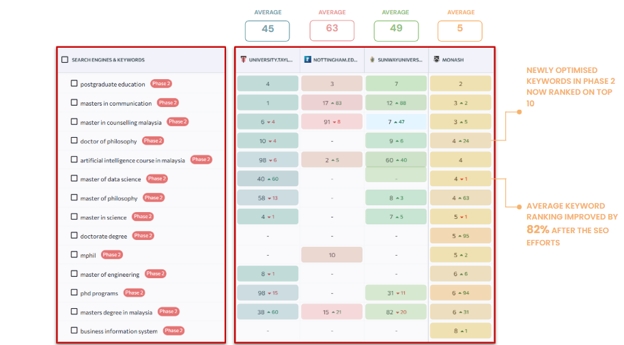
Search engine positioning also improved significantly, with 82% of targeted keywords achieving stronger rankings on Google Malaysia. Notably, over 15 high-value keywords successfully moved into the Top 10 rankings on Google Malaysia, positioning the university competitively in the local academic landscape.

For more information, visit https://imarketing.my/

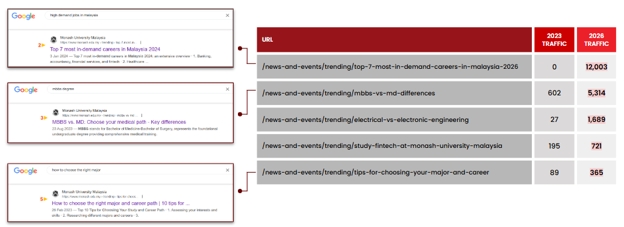
Content-specific paths experienced the most significant gains. The data reveals an almost 16-fold growth in clicks for the article and blog paths, suggesting that the top-of-funnel content is effectively funnelling users toward the university’s primary offerings. Most importantly, the postgraduate course page paths saw almost 500% increase in clicks, directly impacting the visibility of the university’s core academic programmes.

‘Previously, anyone searching for Monash University Malaysia’s postgraduate course pages had difficulty finding them through Google search, limiting organic visibility, reach, and potential student enquiries. With broader improvement to the overall authority and technical health of the website, these pages have seen a surge in traffic, recording a 393.09% growth in Google organic active users,’ said Lim.

The Monash University Malaysia project underscores the importance of search intent-driven strategies in the higher education sector. By prioritising structured data and user-centric content, the agency ensures that educational institutions can maintain a prominent digital presence.

As a specialised SEO company, iMarketing focuses on bridging the gap between complex institutional websites and the algorithms that govern modern search discovery. To enhance visibility on Google, the campaign included optimising the website structure to ensure better user experience and search engine crawlability.

Beyond targeting high-volume keywords, the strategy focused on search terms that reflected user intent, aiming to reach potential students actively searching for specific programmes. The iMarketing team employed a holistic approach to improve search engine rankings, conducting meticulous keyword research for undergraduate and postgraduate courses.

High-quality content played an essential role in establishing authority. The agency developed informative, engaging content, including tailored blog posts and web pages that addressed queries, concerns, and interests. Additionally, targeted backlink campaigns helped the Monash Malaysia website increase its domain authority.

Headquartered in Kuala Lumpur, iMarketing MY continues to provide comprehensive digital solutions for organisations looking to scale their online impact. From education and tech to real estate, the agency helps clients across various sectors navigate the complexities of search engine algorithms, combining technical proficiency with a deep understanding of Google’s evolving content algorithms to deliver measurable, long-term growth.

About the Company:

iMarketing is a premier SEO company headquartered in Kuala Lumpur, dedicated to providing data-backed SEO Services that drive measurable business outcomes. With a focus on technical excellence and content strategy, the SEO Agency assists clients across various sectors in navigating their search engine algorithms. By leveraging advanced analytics, iMarketing optimises digital assets to improve organic rankings and brand authority, ensuring every campaign aligns with a client’s overarching objectives.

Media Contact
Company Name: IMarketing MY
Contact Person: Media Relations
Address:VO2-07-09, Sunway Velocity, Jalan Peel
City: 55100 Kuala Lumpur
State: Federal Territory of Kuala Lumpur
Country: Malaysia
Website: https://imarketing.my/


Formula V Line to Preview Air Power G10 Case with Tilting Front Intake Fans at Computex 2026

22 New Products from Cases to Gaming Chairs

Taipei, Taiwan – May 26th, 2026 – Formula V Line will preview the Air Power G10, a new mid-tower chassis with tilt-adjustable front intake fan mounts, at Computex 2026. The G10 is the lead product in a 2026 lineup of 22 new products spanning computer cases, air coolers, cooling fans, power supplies, and gaming chairs.

The Taiwan-based brand is poised to expand globally through 2026 and into 2027, with North American availability beginning through Newegg and its retail partners in September 2026 and European distribution continuing to build out. The Crystal Z8 Floe and Crystal U9 PA have previously been reviewed by TechPowerUp, with the Crystal U9 PA receiving two editorial awards.

The Air Power G10 Chassis Rethinks Front Intake

For years, front intake on PC cases has worked one way, with fans fixed flat against the panel. The Air Power G10 breaks from that. Its three front intake fans each sit on an independent tilting bracket, so builders can angle each fan to aim airflow toward the GPU, toward the CPU socket area, or anywhere in between.

Each fan bracket is designed for quick release and includes its own nylon dust filter. Builders can remove a single filter for cleaning or replace any of the three fans with their preferred models. The chassis also features a tool-free removable top panel that simplifies radiator installation.

The Air Power G10 also features an interchangeable bottom chamber module that can be repositioned forward or backward, letting builders tune airflow and thermal layout to match the build requirements.

Full specifications, materials, and clearance details for the Air Power G10 will be available at the booth.

Showcase Cases and Cooling Fans with Built-In Displays

Beyond the Air Power G10, the 2026 lineup includes new computer cases built around panoramic glass and showcase airflow, new air cooler series, new cooling fan series including a model with integrated displays, new power supplies, and new gaming chairs. Product naming, full specifications, and launch timing for each will be shared with editors at the booth. Currently shipping models from the Crystal and Air Power case families will also be present for hands-on comparison.

Review Sample Reservations

Visiting editors are invited to inspect the Air Power G10 and the wider 2026 product range at the booth, with hands-on time and briefings with the Formula V Line product engineering team. Editors covering chassis, cooling, and PSU categories are encouraged to discuss early review sample reservations with the team on site, ahead of units shipping for the Newegg launch. Briefings are available in English and Mandarin throughout the show.

Meetings for Distributors and System Integrators

Distributors and system integrators interested in a meeting at Computex can book an appointment at sales@formulav.biz.

Booth Location

Booth I0417a, Hall 1, ground floor.

About Formula V Line

Formula V Line is a Taiwan-based PC hardware and gaming lifestyle brand that designs and engineers cases, cooling solutions, power supplies, and gaming chairs for PC enthusiasts. Its management team brings more than 20 years of combined experience in the PC case and accessories industry. The brand develops original in-house designs backed by continued investment in proprietary tooling, with a focus on price-to-performance across its product range. It works with established manufacturing partners under a controlled quality assurance process.

For more information, visit: www.formulav-line.com.

Media Contact
Company Name: GlobalPR Agency
Contact Person: Mei Chang
Email: Send Email
Country: Taiwan
Website: https://www.GlobalPR.agency

How Did a Stolen OAuth Token Bypass MFA in the $2M Supply Chain Attack?

How Did a Stolen OAuth Token Bypass MFA in the $2M Supply Chain Attack?

Security analyst monitoring a potential supply chain attack on an ultra-wide screen.
Network Threat Detection analyzed the recent Vercel breach, where attackers used a stolen OAuth session token from an infected personal device to bypass multi-factor authentication and access internal systems. The breach exposed around 580 employee records and involved a $2 million ransom demand linked to customer environment variables, highlighting how attackers are increasingly targeting trusted OAuth relationships instead of breaking authentication systems.

Network Threat Detection found that token replay attacks allow access without triggering MFA, making traditional defenses insufficient when session tokens are compromised.

“Network Threat Detection analysis shows this is not a single breach, but a pattern,” said a spokesperson for Network Threat Detection. “Attackers are targeting identity trust chains between vendors, not just credentials.”

Key Findings from the Analysis

  • OAuth token bypassed MFA — Session token reuse enabled access without re-authentication

  • 580 employee records exposed — Internal workspace data accessed during breach

  • $2M ransom demand issued — Linked to customer environment variable exposure

  • 3,750% increase in OAuth phishing — Device code abuse surged from 2025 to 2026 (Push Security, April 2026)

  • 61% of organizations affected — Third-party breaches reported across enterprises (Help Net Security, 2024–2026)

  • 73% rise in malicious packages — Open-source threats growing year-over-year (ReversingLabs, 2026)

  • 1,000+ SaaS environments impacted — Supply chain campaign scale (Mandiant, April 2026)

Attack Chain Breakdown

Network Threat Detection identified a clear sequence in the breach:

  1. Lumma Stealer malware infected a personal device

  2. Google OAuth session token was harvested

  3. Token replay granted access to internal systems

  4. MFA controls were bypassed due to session reuse

  5. Attackers accessed sensitive internal data and issued ransom

This sequence shows how a single compromised endpoint can cascade into broader supply chain exposure.

Why Traditional Defenses Failed

Network Threat Detection analysis highlights structural gaps in current security models:

  • MFA protects login events but not active session tokens

  • OAuth trust relationships extend access across vendors

  • Personal devices introduce unmanaged risk into enterprise systems

  • Third-party integrations expand the attack surface without visibility

“Network Threat Detection data shows that once a trusted token is compromised, the attacker operates inside the system without friction,” the spokesperson added.

Industry-Wide Implications

The breach aligns with a larger trend across supply chain attacks:

  • 500,000 machines impacted in related campaigns (The Register estimate)

  • 340 GB of sensitive data exfiltrated in EU supply chain incident (CERT-EU, April 2026)

  • 90% of open-source malware delivered via npm ecosystems (ReversingLabs, 2025 data)

Network Threat Detection concludes that identity-based attacks are replacing traditional intrusion methods, requiring continuous monitoring of trusted relationships.

Methodology

Network Threat Detection based this analysis on publicly disclosed data from the April 2026 Vercel incident, threat intelligence from Mandiant and CERT-EU, supply chain research from ReversingLabs (2026), and OAuth attack trends from Push Security, cross-referenced with SANS ISC and BleepingComputer reporting.

About Network Threat Detection

Network Threat Detection is a threat modeling and risk intelligence platform focused on identifying exposure across modern attack surfaces. The company provides visibility into third-party risk, identity-based threats, and supply chain vulnerabilities.

Full Study

Find the full study of Supply Chain Attack available on our website.

Q&A

Q: How can an OAuth token bypass multi-factor authentication?

A: OAuth session tokens can be reused after authentication, allowing attackers to access systems without triggering new MFA challenges.

Q: Why are OAuth attacks increasing so rapidly?

A: Attackers are exploiting device code phishing and trusted integrations, which provide indirect access to enterprise systems.

Q: What makes supply chain breaches harder to detect?

A: They occur through trusted vendors and integrations, making malicious activity appear legitimate within systems.

Q: Why is MFA alone not enough to stop these attacks?

A: MFA protects initial login, but not ongoing sessions where tokens are already validated.

Q: What is the main risk highlighted by this breach?

A: The growing attack surface created by interconnected SaaS platforms and shared identity systems.

Media Contact
Company Name: Network Threat Detection
Contact Person: Media Relations
Email: Send Email
Phone: +1 760-520-2304
Address:4733 Fincham Road
City: San Diego
State: California 92111
Country: United States
Website: http://www.networkthreatdetection.com/

MSSP Security Consulting Finds 365x Gap in Agentic AI & AI SOC Automation, but 95% of SOCs Cannot Deploy

MSSP Security Consulting Finds 365x Gap in Agentic AI & AI SOC Automation, but 95% of SOCs Cannot Deploy

Cybersecurity analyst monitoring real-time threats using AI SOC Automation.

FULLERTON, Calif. – MSSP Security Consulting, a vendor-agnostic consulting firm focused on cybersecurity product strategy and auditing for Managed Security Service Providers (MSSPs), today released an analysis showing a critical disconnect in security operations: AI agents can process up to 2,000 incidents per day, approximately 365 times the annual capacity of a human analyst, yet only 1–5% of Security Operations Centers (SOCs) have deployed them in production. 

The findings, based on multiple industry reports published between March and April 2026, identify governance, not technology, as the primary barrier to adoption. While 85% of enterprises are piloting AI agents, only 5% have operationalized them, leaving a significant gap between capability and execution.

“The technology is ready, but the governance framework to use it safely is not,” said Richard K. Stephens, Founder of MSSP Security Consulting. “You cannot deploy autonomous systems at scale without defining how they behave, how they are measured, and who is accountable.”

Key Findings from the Analysis

  • 365x capacity gap: AI agents process ~2,000 incidents daily vs. 1,800–2,000 annually per human analyst (Gartner, April 2026)

  • Low production adoption: Only 1–5% of SOCs have deployed AI agents live (Arctic Wolf, April 2026)

  • Pilot-to-production gap: 85% piloting vs. 5% production adoption (Cisco, RSAC 2026)

  • Breakout speed compression: Fastest adversary lateral movement now 27 seconds; average 29 minutes (CrowdStrike, RSAC 2026)

  • Expanding attack surface: Over 1,800 AI applications detected on enterprise endpoints (CrowdStrike)

  • Governance as top barrier: 51% of MSPs cite compliance and governance concerns (AvePoint & Omdia, April 2026)

  • Data readiness gap: 94% investing in AI readiness; only 43% report high maturity

  • Industry shift underway: 78% of MSPs expect AI to reshape security operations in 2026 (Seceon Inc.)

Governance Gap Slows AI Deployment

MSSP Security Consulting’s analysis highlights that most organizations successfully validate AI performance in controlled pilots but fail to transition into production due to unresolved governance challenges.

Key operational blockers include:

  • Lack of defined behavioral baselines for AI agents

  • Limited auditability of autonomous decisions

  • Unclear accountability for automated actions

  • Compliance risks across regulated environments

  • Integration complexity with SIEM, SOAR, and ticketing systems

“The real question is no longer which AI platform to buy,” Stephens added. “It is whether organizations have the governance maturity to manage autonomous decision-making in live environments.”

Market Implications and Opportunity

The report aligns with Omdia’s forecast of a $276 billion partner services opportunity by 2030, driven by demand for consulting, integration, and governance frameworks supporting AI adoption.

MSSP Security Consulting notes that MSSPs addressing governance early will be positioned to accelerate adoption and capture emerging service demand, particularly in regulated industries where compliance requirements are stringent.

Methodology

This analysis is based on publicly available data from reports, surveys, and keynote presentations published between March and April 2026, including Gartner, Arctic Wolf, Cisco (RSAC 2026), CrowdStrike (RSAC 2026), AvePoint & Omdia, Seceon Inc., and Stratistics MRC.

About MSSP Security Consulting

MSSP Security Consulting is a vendor-agnostic advisory firm specializing in cybersecurity technology evaluation, selection, and optimization for Managed Security Service Providers. The firm provides guidance across SIEM, SOAR, EDR/XDR, threat intelligence, and cloud security environments.

Full Study

Find the full study of AI SOC Automation available on our website.

Q&A

Q: Why are AI agents not widely deployed in SOCs despite proven capability?

A: Governance and compliance challenges, such as auditability, accountability, and integration complexity, prevent organizations from moving beyond pilot environments.

Q: What is the significance of the 365x capacity gap?

A: It reflects a fundamental shift in operational scale, where AI can process a full year’s workload in a single day, requiring new oversight models.

Q: How does breakout time impact SOC strategy?

A: With adversaries moving in as little as 27 seconds, manual response models are no longer viable, increasing reliance on autonomous systems.

Q: What should MSSPs prioritize for AI adoption?

A: Establishing governance frameworks, defining agent behavior, and ensuring compliance alignment before deploying AI into production.

Media Contact
Company Name: MSSP Security Consulting
Contact Person: Richard K. Stephens
Email: Send Email
Phone: +1 (951) 237-2057
Address:2919 Hillcrest Lane
City: Fullerton
State: California 93632
Country: United States
Website: https://msspsecurity.com/service/#JOIN

Application Security Training is Broken: 85% of Companies Require It, But Developers Aren’t Asking for It

Application Security Training is Broken: 85% of Companies Require It, But Developers Aren’t Asking for It

A developer completing Application Security Training modules on a multi-monitor setup.

ALBANY, N.Y. – Secure Coding Practices released a new analysis of three independent studies showing a clear disconnect in application security training: 85% of organizations mandate AppSec training, yet 0% of developers have ever requested it. The data indicates that compliance requirements, not developer demand, are driving training decisions, resulting in low engagement, workflow disruption, and measurable productivity loss across engineering teams.

Secure Coding Practices found that this misalignment contributes to what many teams describe as a “defensive tax,” where engineering time is spent reacting to vulnerabilities instead of preventing them. In large enterprises, this cost exceeds $1.2 million annually.

“Secure Coding Practices sees a consistent pattern: training is delivered for compliance, not for how developers actually work,” said Leon I. Hicks, founder of Secure Coding Practices. “Secure Coding Practices analysis shows developers are not rejecting security. They are rejecting training that interrupts flow and lacks relevance.”

Key Findings from the Analysis

  • 85% mandate training, 0% request it, Training is required but not developer-driven (Security Compass, March 31, 2026)

  • 57% driven by compliance, Organizations prioritize regulatory needs over skill development

  • 58% reactive workload, AppSec teams spend more than half their time chasing vulnerabilities (Backslash Security, March 30, 2026)

  • 89% defensive tax exposure, At least a quarter of time spent on reactive tasks

  • $1.2M annual cost, Estimated productivity loss in large enterprises

  • 25% overwhelmed by volume, Developers report high vulnerability load (Pynt, April 9, 2026)

  • 35% impacted by false positives, Noise reduces trust in security tooling

  • 86% adopting AI/ML, Security strategies evolving, but training models lag

Where AppSec Training Breaks Down

Secure Coding Practices analysis highlights that current training models fail to align with real development environments.

  • Training is delivered outside developer tools, forcing context switching

  • Content is generic, not tied to real vulnerabilities or codebases

  • Completion metrics replace skill-based measurement

  • Shift-left tools increase alerts without improving developer knowledge

  • Training remains event-based, not integrated into daily workflows

“Secure Coding Practices data shows that shift-left moved tools earlier, but did not move knowledge with them,” Hicks said. “This creates overload instead of improvement.”

Operational Impact on Engineering Teams

The gap between training and real-world application creates measurable inefficiencies:

  1. Developers spend more time triaging alerts than writing secure code

  2. AppSec teams operate reactively instead of building prevention strategies

  3. False positives reduce trust in security systems

  4. Training completion does not translate into vulnerability reduction

Secure Coding Practices concludes that without alignment between training, tools, and workflows, organizations will continue to see low ROI from AppSec programs.

Methodology

Secure Coding Practices based this analysis on publicly available data from Security Compass/Golfdale Consulting (150 professionals, US/Canada/UK, March 31, 2026), Backslash Security (300 AppSec professionals, US enterprises with 1,000+ employees, March 30, 2026), and Pynt (shift-left adoption survey, April 9, 2026).

About Secure Coding Practices

Secure Coding Practices is a developer-focused training company that provides hands-on programs for building secure software. The company works with engineering teams to improve secure coding practices across frontend, backend, DevOps, and leadership roles.

Full Study

Find the full study of Application Security Training available on our website.

Q&A

Q: Why do companies require AppSec training if developers do not request it?

A: Secure Coding Practices analysis shows compliance requirements, not developer demand, drive training decisions in most organizations.

Q: What is the “defensive tax” in AppSec teams?

A: It refers to time spent reacting to vulnerabilities instead of preventing them, costing large enterprises over $1.2 million annually.

Q: Why do developers disengage from AppSec training?

A: Training is often generic, delivered outside developer tools, and disconnected from real coding workflows.

Q: How does shift-left impact developer workload?

A: Shift-left increases exposure to vulnerabilities but often lacks corresponding knowledge transfer, leading to overload.

Q: What is the main gap in current AppSec training models?

A: The lack of alignment between training content, developer workflows, and real-world vulnerability scenarios.

Media Contact
Company Name: Secure Coding Practices
Contact Person: Leon I. Hicks
Email: Send Email
Phone: +1 (518) 813-2007
Address:188 Elk Rd
City: Albany
State: New York
Country: United States
Website: https://securecodingpractices.com/

Strider Announces Its Florist OrderFlow Program to Address Seasonal Order Variability in Flower Retail Sector

Wilmington, DE – May 26, 2026 – Strider, a marketing agency serving floral retailers, has announced the rollout of Florist OrderFlow, a structured digital marketing initiative aimed at addressing seasonal fluctuations in order volumes experienced by flower shops across the United States.

Florists commonly experience uneven sales cycles throughout the year, with reduced demand often observed during summer months. These variations can create operational challenges related to staffing levels, revenue planning, and the management of perishable inventory. Industry stakeholders have increasingly explored digital customer acquisition strategies as a way to stabilize order flow during lower-demand periods.

Florist OrderFlow is designed as a campaign-based system focused on generating flower shop online orders through digital advertising channels. The initiative is positioned within Strider’s broader florist marketing services, which emphasize paid media management and search-based customer acquisition strategies tailored specifically for floral businesses.

Strider has operated in the floral marketing sector since 1994 and is recognized as an agency with specific expertise in flower shop advertising. Founded by a fifth-generation florist with more than 32 years of combined industry and digital marketing experience, the company also operates as a Google Partner Agency.

Ryan Freeman from Strider said: “Florists face recurring seasonal shifts that can make planning and operations difficult. Florist OrderFlow was developed to introduce a more consistent stream of online inquiries and orders through structured digital campaigns, helping shops better navigate slower periods of demand,” he said.

Company-provided data from mature campaign implementations indicates typical performance ranges that include cost-per-acquisition levels between $12 and $15, with monthly order volumes averaging 50 to 62 transactions and average order values between $105 and $115. These figures are presented as observed campaign outcomes and may vary depending on market conditions and execution.

The Florist OrderFlow program is available in multiple configurations, including an entry-level option intended to support floral retailers seeking to establish or expand digital order acquisition systems. According to the company, the program is designed to provide flexible advertising support for flower shops of varying sizes and operational models.

About Strider

Strider is a Wilmington, Delaware-based marketing agency specializing in digital advertising services for flower shops. The company focuses on paid media and search marketing strategies designed for floral retailers. More information is available at https://strider4florists.com/florist-orderflow.

Media Contact
Company Name: Strider
Contact Person: Ryan Freeman
Email: Send Email
Phone: 800-314-8895
Country: United States
Website: https://strider4florists.com/florist-orderflow

Must Love Futbol Launches Global Football Travel and Fan Culture Platform Ahead of FIFA World Cup 2026

Boston, MA – May 26, 2026 – Must Love Futbol, a new football travel and fan culture platform, has officially launched to help supporters plan World Cup 2026 travel, explore host city guides, follow scores and fixtures, and discover football culture beyond the stadium. Built around the belief that football is the only language spoken everywhere, the platform was created for fans who see the sport as more than just 90 minutes on the pitch.

As anticipation builds for the 2026 FIFA World Cup across the United States, Canada, and Mexico, Must Love Futbol is positioning itself as more than a tournament-focused media platform. While World Cup 2026 represents a major moment for football fans worldwide, the company’s broader vision centers on helping people find the game wherever they travel — from world-famous stadiums to neighborhood pitches and local supporter gatherings.

The 2026 FIFA World Cup is expected to become the largest tournament in football history, expanding to 48 teams and 104 matches across multiple host cities. With millions of supporters expected to travel throughout North America, the need for trusted football travel guidance, matchday information, and local culture insights continues to grow. Must Love Futbol was created to meet that demand while also building a long-term platform dedicated to global football culture year-round.

“Football is not just something people watch for 90 minutes — it’s something people live every day across every part of the world,” said Ameeth Deenanath, founder of Must Love Futbol. “We built Must Love Futbol for the fans who feel that connection wherever the game takes them — from the World Cup to women’s football, local clubs, supporter culture, and football communities around the world.”

Must Love Futbol offers a growing collection of football-focused resources, including host city travel guides, tournament fixtures, live scores, travel planning content, and cultural insights designed to help fans experience football on a deeper level. The platform also plans to expand coverage around men’s football, women’s football, global leagues, local clubs, supporter culture, and future community features that encourage connection between fans around the world.

In addition to helping supporters navigate major tournaments, the platform aims to spotlight the local football communities that define the sport globally. From grassroots pitches to iconic matchday traditions, Must Love Futbol is committed to showcasing the people, places, and stories that make football the world’s most universal game.

“As the global football community continues to grow, we want Must Love Futbol to become a trusted place where fans can discover the culture, energy, and community surrounding the sport,” added Deenanath. “The World Cup is an important chapter, but the vision extends far beyond one tournament.”

Must Love Futbol is live now and will continue expanding its platform features and editorial coverage leading up to the 2026 FIFA World Cup.

To learn more about Must Love Futbol and explore football travel guides, scores, fixtures, and fan culture content, visit mustlovefutbol.com.

Fans can also follow Must Love Futbol across social media for ongoing updates surrounding World Cup 2026 planning, football travel insights, live scores, host city coverage, supporter culture, and future community features. Regular updates and football content are available on Instagram at @‌mustlovefutbol and through the platform’s official website.

About Must Love Futbol

Must Love Futbol is a football travel, scores, and fan culture platform built for supporters who see the sport as more than a game. Inspired by the idea that football is the only language spoken everywhere, the platform offers World Cup 2026 planning resources, host city guides, live scores, travel insights, and coverage across the global football landscape. From major tournaments and women’s football to local clubs, grassroots football culture, and supporter traditions, Must Love Futbol explores how the sport connects communities around the world. Through digital content and evolving community features, the brand helps fans discover football wherever their journey takes them.

Media Contact
Company Name: Must Love Futbol
Contact Person: Ameeth Deenanath
Email: Send Email
Phone: 617-606-3632
Country: United States
Website: https://mustlovefutbol.com/

New River Ellington Workbook Brings Therapist-Backed Coping Skills to Teens With Anxiety and Stress

Nearly 4 in 10 teens report persistent sadness. A new workbook gives them the skills to push back, with ACT, CBT, and DBT tools for anxiety, stress, and emotional overwhelm.

Staten Island, NY – May 26, 2026 – In 2023, 39.7% of U.S. high school students reported persistent feelings of sadness or hopelessness, according to the CDC’s most recent Youth Risk Behavior Survey. More than 1 in 5 seriously considered attempting suicide. Behind those numbers are millions of teens who often cannot find the words to explain what they feel, and parents who don’t know how to help beyond “just calm down” or “think positive.”

A new release from author River Ellington aims to close that gap. The Complete Teen Mental Health Workbook, written for ages 13 to 19, brings together three of the most widely used evidence-based therapeutic approaches: Acceptance and Commitment Therapy (ACT), Cognitive Behavioral Therapy (CBT), and Dialectical Behavior Therapy (DBT).

A skills gap, not just a feelings gap

Teen mental health conversations often focus on diagnosis and crisis. But for many teens, the daily reality is smaller and quieter. A test that triggers panic. A social moment that replays all night. An argument that turns into regret. A wave of sadness that makes ordinary tasks feel heavy. Without language or tools, those moments often arrive as “I’m fine.”

“Too many teens are carrying real distress with no vocabulary for it,” says Ellington. “These aren’t kids who need a lecture. They need skills, the same skills therapists teach, written in a way that actually fits a teenager’s life.”

That premise has resonated with clinicians who work with adolescents. Lilla Dale McManis, MEd, PhD, a psychologist experienced with teens facing mental health challenges, says the workbook delivers what adolescents actually need: resources that are “accurate, relatable, non-judgmental, and actionable.” In her review, she notes that the book translates complex ACT, CBT, and DBT concepts into accessible language so teens learn both “the ‘why’ and the ‘how’ to tackle emotions, thoughts, and behaviors,” helping them navigate personal, social, academic, and family challenges while building long-term resilience.

The workbook’s structure reflects that goal. CBT chapters help teens notice and challenge unhelpful thought patterns. ACT chapters help them make room for difficult emotions while still acting on what matters to them. DBT chapters give them concrete tools, including mindfulness, distress tolerance, emotion regulation, and interpersonal effectiveness, for moments when feelings feel too big to handle.

Clinical psychologist Marina Leybina, who reviewed the workbook, says it has a “solid foundation in evidence-based therapeutic approaches” and praises its progressive structure. She singles out the tone as “soft, nonclinical, and engaging,” which she says matters for reducing stigma in adolescent mental health materials. She also highlights the book’s metaphors, like the “dashboard lights” framing used to explain emotional signals, as making psychological concepts feel immediately relevant to young readers. The exercises, she adds, including journaling prompts, trigger tracking, and emotion labeling, “align with best therapeutic practice and encourage active participation rather than passive reading.”

That practical, hands-on design is also what stands out to educators. Jacie Veno, an experienced teacher and curriculum expert, points to the workbook’s emphasis on personalization as one of its greatest strengths. Readers are guided to build their own “emotional toolbox,” identifying strategies that work for them, whether that means journaling, music, movement, or mindfulness. Engaging visuals, relatable examples, and QR codes linking to bonus resources reinforce the learning, and Veno notes that the book reframes setbacks as opportunities for growth. She calls it “both educational and empowering,” and recommends it to teens, educators, and caregivers alike.

A supplement, not a substitute

All three reviewers emphasize a point Ellington stresses as well: workbooks are tools for self-awareness and skill-building, not replacements for professional care. Leybina notes that the book’s disclaimers and encouragement to seek professional help are “appropriate and ethically sound,” clearly positioning it as a supplement rather than a substitute for therapy. Parents whose teens talk about self-harm, feel unsafe, cannot function, or show sudden major changes in mood, sleep, appetite, or school engagement are urged to seek help from a licensed mental health professional, school counselor, pediatrician, or emergency support.

About River Ellington

River Ellington is a Staten Island-based author committed to helping teens build real-world skills for navigating adolescence and adulthood with confidence. As a father of two, he combines personal insight with research-driven strategies to create accessible, engaging resources for young readers. Learn more at River Ellington’s Amazon Author Page.

Media Contact
Company Name: River Ellington
Contact Person: River Ellington
Email: Send Email
Country: United States
Website: https://amzn.to/4ukMtFm

HMPI Continues to Strengthen Overseas Corporate Service Network to Support Global Business Expansion

As global digital industries continue to evolve, an increasing number of Asian companies are accelerating their expansion into overseas markets. Alongside this trend, demand for comprehensive overseas business support services is also growing rapidly.

Against this backdrop, HMPI, a company focused on cross-border corporate services, is continuing to expand and strengthen its international service network. The company currently provides business support solutions across multiple regions including the United Arab Emirates, the Philippines, Sri Lanka, Georgia, Armenia, and Timor-Leste, offering services such as office solutions, accommodation arrangements, visa assistance, compliance support, and local operational coordination for overseas enterprises.

In recent years, markets such as Dubai and Abu Dhabi have attracted growing attention from international businesses. Supported by an open commercial environment, modern infrastructure, and continuously developing free zone policies, the UAE has increasingly become a strategic destination for cross-border companies establishing overseas operations.

According to HMPI, today’s overseas expansion is no longer simply about renting office space. Companies are now placing greater emphasis on operational efficiency, long-term stability, and integrated local support systems. This is particularly true for businesses involved in digital technology, cross-border internet services, and international trade sectors, where operational requirements often extend beyond workspace to include employee accommodation, visa processing, administrative coordination, and local resource integration.

“Many companies entering overseas markets are not only looking for office facilities,” an HMPI representative stated. “What they truly need is a reliable long-term partner capable of helping them establish stable operations efficiently in a new market.”

In addition to the Middle East, HMPI continues to monitor opportunities across Southeast Asia and emerging international markets. The Philippines remains attractive for international operational teams due to its English-speaking workforce and established labor infrastructure. Sri Lanka has also begun drawing attention from certain international companies because of its cost advantages and regional positioning. Meanwhile, Georgia and Armenia are increasingly being considered by technology-oriented businesses seeking flexible international expansion opportunities.

Industry observers believe that the overseas corporate services sector is undergoing a significant transformation. Rather than focusing solely on office leasing, companies are increasingly seeking comprehensive support platforms capable of assisting with long-term international operations.

As more enterprises transition toward globalized business models, demand for integrated overseas operational services is expected to continue growing. Businesses are now paying closer attention to factors such as regional experience, local operational capabilities, resource integration, and long-term service stability when selecting overseas partners.

HMPI stated that it will continue expanding its regional service capabilities while enhancing localized support resources to provide more efficient and stable overseas business solutions for international companies entering global markets.

Media Contact
Company Name: HMPI
Contact Person: William,Wu
Email: Send Email
City: Colombo
Country: Sri Lanka
Website: www.hmpi.info

Becoming: Five Generations in One Workplace – Transcending America Explores Faith, Generational Leadership, and the Evolving American Workplace

Becoming: Five Generations in One Workplace - Transcending America Explores Faith, Generational Leadership, and the Evolving American Workplace

In today’s evolving workforce, understanding across generations is no longer optional, it is essential. George W. McDuffie presents a timely conversation on leadership, culture, and collaboration in the modern workplace.
Author George W. McDuffie delivers a timely and thought-provoking perspective on generational dynamics, spiritual values, and cultural transformation in modern America.

At a time when workplaces across America are navigating unprecedented generational diversity, author George W. McDuffie presents a compelling and deeply reflective new book, Becoming: Five Generations in One Workplace – Transcending America, offering readers a unique examination of faith, leadership, culture, and the evolving American workforce.

Blending historical analysis, biblical principles, cultural commentary, and workplace insight, the book explores how multiple generations coexist within modern society and how shared values can bridge ideological, cultural, and spiritual divides.

In today’s workforce, it is increasingly common to find five generations working side by side. From the Silent Generation to Generation Z, each group brings distinct experiences, perspectives, values, and expectations into the workplace. Through Becoming: Five Generations in One Workplace – Transcending America, McDuffie examines how these differences shape organizational culture, leadership dynamics, communication styles, and societal progress.

The book presents a broader message beyond workplace behavior. It reflects on America’s historical and spiritual foundations while encouraging readers to pursue unity, understanding, and personal growth across generations.

Drawing inspiration from historical movements such as the Women’s Suffrage Movement, the Civil Rights Movement, and major generational turning points throughout American history, McDuffie connects past struggles and societal transformations with present-day cultural realities.

Throughout the manuscript, the author emphasizes themes of faith, resilience, responsibility, and collective progress. The work challenges readers to think critically about how values are passed from one generation to the next and how spiritual and moral foundations continue to influence American identity.

“Each generation continues to pursue equal opportunity, social, and economic progress,” McDuffie writes, reinforcing the book’s central theme of generational responsibility and transcendence.

One of the book’s strongest distinguishing qualities is its ability to merge spiritual reflection with contemporary workplace discussion. Rather than focusing solely on generational stereotypes, the book positions each generation as part of a larger societal continuum, connected through shared responsibility, evolving cultural values, and the pursuit of purpose.

The author also addresses the increasing influence of technology, shifting moral frameworks, and changing communication patterns among younger generations, particularly Millennials and Generation Z, while maintaining a strong emphasis on faith-centered leadership and social responsibility.

With workplace culture becoming one of the defining conversations of the modern era, Becoming: Five Generations in One Workplace – Transcending America arrives as a timely contribution for business leaders, educators, faith communities, organizational professionals, and readers seeking a deeper understanding of generational coexistence in America.

The book’s message ultimately centers on unity. While generations may differ in worldview, technology, communication styles, and social perspectives, McDuffie argues that shared humanity, faith, and mutual respect remain the foundation for meaningful progress.

About the Author

George W. McDuffie is an author and thought leader whose work focuses on generational development, faith, American culture, and workplace transformation. Through his writing, he explores how historical movements, spiritual values, and evolving social dynamics continue to shape modern society. His work encourages readers to embrace understanding, unity, and purpose across generations.

About the Book

Becoming: Five Generations in One Workplace – Transcending America explores the coexistence of five generations within the American workplace and society, examining how faith, history, leadership, and cultural transformation influence the evolving modern world.

Buy now: https://www.amazon.com/BECOMING-GENERATIONS-WORKPLACE-TRANSCENDING-AMERICA-ebook/dp/B0GS6L8VG4

Learn more: www.gwmcduffie.com

Media Contact
Company Name: George W. McDuffie
Contact Person: George W. McDuffie
Email: Send Email
City: New York
State: New York
Country: United States
Website: www.gwmcduffie.com