
Cold Chain Market to Reach $455.0 Billion by 2031, Growing at a CAGR of 10.5% – Exclusive Report by MarketsandMarkets™

“MarketsandMarkets™”
Cold Chain Market By Type, Temperature Type (Chilled, Frozen, and Deep-frozen), Application (Food & Beverages, Pharmaceuticals), Technology (Blast Freezing, Vapor Compression, Programmable Logic Controller), and Region – Global Forecast to 2031

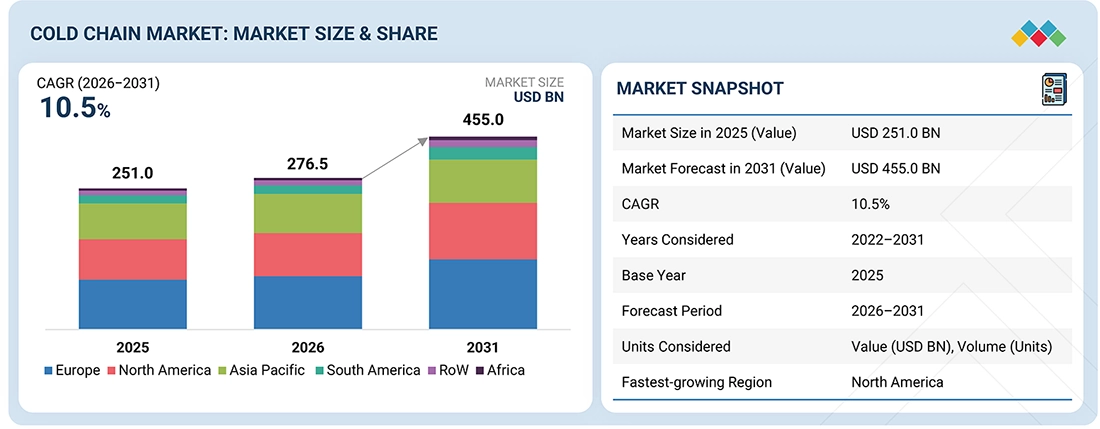
According to a research report published by MarketsandMarkets™, The cold chain market is estimated at USD 276.5 billion in 2026 and is projected to reach USD 455.0 billion by 2031, at a CAGR of 10.5% from 2026 to 2031. Temperature-controlled logistics are gaining more and more prominence in many industries; hence, the market is experiencing substantial growth. In the healthcare industry, it is critical that medications and vaccines undergo proper temperature control so that they remain safe and effective. With an increase in the number of drugs that are more vulnerable to temperature, there is a need for adequate cold chain capabilities.

In the food and beverage industry, the cold chain process is necessary in preserving fresh goods and increasing shelf life, thus ensuring minimal losses of perishable foods such as dairy products, meat, seafood, fruits, vegetables, juices, and other beverages. The chemical industry also needs cold chains since many chemicals and raw materials require temperature control for their safety and effectiveness.

Besides this, there are a number of other uses of cold chain logistics. Temperature-controlled environments are also vital when it comes to the storage and transportation of important pieces of artwork, as well as historical relics. Extreme temperatures may harm the functioning of certain electronic devices. Flowers and plants, too, need temperature-controlled logistics to maintain their freshness. Consequently, cold chains have become necessary in order to maintain product quality and safety in many different industries.
Cold Chain Market

Market Size and Growth Forecast

  • Market Size in 2025 (Value): USD 251.0 Billion
  • Market Forecast in 2030 (Value): USD 455.0 Billion
  • Growth Rate: CAGR of 10.5% during 2026-2031
  • Years Considered: 2022–2031
  • Base Year: 2025
  • Forecast Period: 2026–2031
  • Units Considered: Value (USD Billion), Volume (Units)
  • Report Coverage: Revenue forecast, company ranking, competitive landscape, growth factors, and trends


Download PDF Brochure: https://www.marketsandmarkets.com/pdfdownloadNew.asp?id=811

By type, the cold chain storage & infrastructure segment accounts for a significant market share.

Cold chain storage & infrastructure is one of the largest segments within the cold chain market, owing to the rising requirement for temperature-controlled warehousing and logistics for different industries like food & beverages, pharma, and chemicals. Increased consumption of perishable goods, growth in organized retailing and online grocery delivery, along with increased requirements in pharmaceuticals, have led to investment in refrigerated storage solutions and monitoring systems. Growth in international trade in temperature-controlled goods has added to the demand for cold chain solutions, ensuring that products do not spoil.

Developments in technology related to the cold chain infrastructure include IoT-based temperature monitoring equipment, automated refrigerators, and energy-efficient storage facilities, and all of these are contributing towards the growth of this segment. Governmental as well as private sector initiatives for developing modern cold storage facilities are aimed at improving food security levels, minimizing post-harvest losses, and ensuring compliance with regulations regarding pharmaceutical/biological materials. The adoption of cold chain logistics across emerging nations will continue to drive the expansion of this segment going forward.

By refrigerated road transportation type, the refrigerated LCV segment is estimated to maintain strong growth.

The versatility and agility of refrigerated LCVs make them ideal for navigating through urban areas and reaching smaller distribution points, thereby offering enhanced accessibility to a wider range of customers. Additionally, the lower operational costs associated with LCVs, including fuel consumption and maintenance expenses, render them more economically viable for businesses operating within the cold chain sector. Moreover, the increasing emphasis on sustainability and environmental concerns has prompted a shift towards smaller, more fuel-efficient vehicles like LCVs, aligning with the industry’s efforts to reduce carbon emissions and minimize ecological impact.

Request Sample Pages: https://www.marketsandmarkets.com/requestsampleNew.asp?id=811

Based on region, Europe accounts for a significant market share.

The region holds a considerable share in the global cold chain market owing to high demand for temperature management solutions within food and beverages, pharmaceutical, and healthcare sectors. The presence of stringent laws governing food security, transportation of pharmaceutical products, and product quality has led to the widespread use of advanced refrigeration technology. The regulatory policies implemented by the European Union help to build cold chains in an effective manner that helps to save food waste and ensure product integrity.

Nations like Germany, France, the UK, Italy, and the Nordic countries continue to experience constant investments in their cold storage facilities and refrigeration warehousing services. The continent has good transport and logistical infrastructure, which, coupled with the adoption of modern digital technology such as the Internet of Things (IoT), enhances its attractiveness for cold chain logistics. Moreover, the rising demand for frozen foods, biologics, vaccines, and fresh produce continues to make Europe an important player in the international cold chain logistics market.

Leading Cold Chain Companies:

The report profiles key playerssuch as Americold Logistics, Inc. (US), Lineage, Inc. (US), NICHIREI CORPORATION (Japan), Burris Logistics (US), A.P. Moller – Maersk (Denmark), Tippmann Group (US), Coldman Logistics Pvt. Ltd. (India), and United States Cold Storage (US).

Recent Developments in the Cold Chain Industry:

  • May 2026: Americold expanded its partnership with PLUS, a Dutch supermarket cooperative with around 440 stores, to centralize frozen logistics operations across the Netherlands. Through its Barneveld distribution center, Americold will manage storage, handling, and distribution of frozen products, helping PLUS improve supply chain efficiency, service quality, and nationwide logistics integration.
  • April 2026: The Nichirei Logistics Group acquired two cold chain companies based in Indonesia, namely PT Mega Indo Logistik and PT Mega Internasional Sejahtera, as consolidated subsidiaries. This acquisition is in keeping with the company’s efforts to develop its temperature-controlled logistics network within ASEAN as well as to enhance overseas expansion in Indonesia’s booming cold chain industry.
  • April 2025: Lineage, Inc. is planning on adding more cold storages within the United States through acquisitions, greenfield development, and automation. In connection with its strategic vision, the firm has entered into a deal to purchase several cold storage units from Tyson Foods. This would help reinforce the long-term relationship that has been built between Lineage and Tyson. Lineage will be building and operating two highly automated cold storage facilities, with Tyson Foods being the key customer of these operations.


Make an Inquiry: https://www.marketsandmarkets.com/Enquiry_Before_BuyingNew.asp?id=811

About MarketsandMarkets™

MarketsandMarkets™ has been recognized as one of America’s Best Management Consulting Firms by Forbes, as per their recent report.

MarketsandMarkets™ is a blue ocean alternative in growth consulting and program management, leveraging a man-machine offering to drive supernormal growth for progressive organizations in the B2B space. With the widest lens on emerging technologies, we are proficient in co-creating supernormal growth for clients across the globe.

Today, 80% of Fortune 2000 companies rely on MarketsandMarkets, and 90 of the top 100 companies in each sector trust us to accelerate their revenue growth. With a global clientele of over 13,000 organizations, we help businesses thrive in a disruptive ecosystem.

The B2B economy is witnessing the emergence of $25 trillion in new revenue streams that are replacing existing ones within this decade. We work with clients on growth programs, helping them monetize this $25 trillion opportunity through our service lines – TAM Expansion, Go-to-Market (GTM) Strategy to Execution, Market Share Gain, Account Enablement, and Thought Leadership Marketing.

Built on the ‘GIVE Growth’ principle, we collaborate with several Forbes Global 2000 B2B companies to keep them future-ready. Our insights and strategies are powered by industry experts, cutting-edge AI, and our Market Intelligence Cloud, KnowledgeStore™, which integrates research and provides ecosystem-wide visibility into revenue shifts.

Media Contact
Company Name: MarketsandMarkets™ Research Private Ltd.
Contact Person: Mr. Rohan Salgarkar
Email: Send Email
Phone: 18886006441
Address:1615 South Congress Ave. Suite 103, Delray Beach, FL 33445
City: Florida
State: https://www.marketsandmarkets.com/Market-Reports/cold-chain-market-811.html
Country: United States
Website: https://www.marketsandmarkets.com/Market-Reports/cold-chain-market-811.html


Press Release Distributed by ABNewswire.com

To view the original version on ABNewswire visit: Cold Chain Market to Reach $455.0 Billion by 2031, Growing at a CAGR of 10.5% – Exclusive Report by MarketsandMarkets™


Electronic Waste Recycling Market Report 2026: Market Size, Market Share & Industrial Digital Transformation Forecast to 2029 | Expert Review

The electronic waste recycling market is expanding rapidly due to rising e-waste generation, increasing environmental regulations, and growing awareness of resource recovery. Leading companies are investing in advanced recycling technologies and sustainable processing solutions to improve material extraction efficiency. With the global focus on circular economy initiatives, the market is expected to witness significant growth and innovation in the coming years.

The Electronic Waste Recycling market is projected to grow from USD 48.41 billion in 2024 to USD 66.33 billion by 2029, at a CAGR of 6.5% during the forecast period. The report delivers in-depth insights into key market dynamics, including regional growth trends, electronic waste recycling market demand, market segmentation, CAGR projections, and the revenue performance of leading industry players.

The demand for electronic waste recycling is driven by rising advancement in electronics technologies, growing investments, government initiatives and increasing focus towards sustainability. Electronic waste recycling include collecting, sorting, shredding and recovery of materials from older scrapped electronic devices. These recycled materials are then distributed to numerous industries through various delivery systems. Electronic waste market considered here includes only the formalized recycling market established worldwide, with proper data management and accounting. The formal electronic waste market accounts for about 20 – 25% of total e-waste that is generated globally every year. The rest of the e-waste generated ends up in informal recycling market and landfill. The data related to recycling in informal market is unavailable as there is no proper record for the volume of material recycled or where is it used in further processing, how much value is extracted out of this recycling. These informal recycling is more prevalent in under-developed economies where the local vendors try to refurb and recycle the older electronic hardware that is not following best industrial practices. We have covered the formalized market alone in this report.

Download PDF Brochure: https://www.marketsandmarkets.com/pdfdownloadNew.asp?id=152870675

Metals segment is expected to grow with highest CAGR in Electronic Waste Recycling Market during the forecasted period.

The Electronic Waste Recycling Market is segmented based on the material into Metals, Glass, Plastics and other materials. Metals are the high value materials that the electronic recyclers are heavily dependent to recover their operating cost and achieve profitability. Although high value metals are present in a very less volume, owing to their demand in the market these recyclers are able to make huge returns on these material segment. Common metals that is recycled and recovered from electronic waste includes aluminum, copper, lithium, gold, silver, palladium, tin nickel and lead. Of these materials, gold, lead, palladium generate the higher value, even with overall volume of these metals remain very low. Recyclers are constantly looking for electronic components that contains these mentioned materials to recover and resell them to achieve profitability. With ongoing price trend of these materials, companies are actively looking to increase their processing capacity of these materials above other materials such as glass, plastics and others.

IT & Telecommunication is expected to grow with highest CAGR in Electronic Waste Recycling Market during the forecasted period.

The Electronic Waste Recycling Market is segmented based on source into Household Appliances, Consumer Electronics, IT & Telecommunications, Mobile Computing Devices, and other sources. IT & Telecommunication segment is the largest point source of electronic scrap for the recyclers in the formalized recycling market. These companies are also bound by regulatory compliances to responsibly dispose of their older devices. With rising requirement for computational power with emerging technologies, the generation of electronic scrap is expected to increase, which in turn increases the responsibility of the companies to responsibly dispose these devices through recycling of these devices through partnerships with recycling companies.

Lithium Battery Recycling technology segment is expected to have largest share during forecasting period in terms of value.

Lithium battery recycling is a complex process which involves usage of all the technologies combined so as to remove very few materials of choice, resulting in higher unit cost of recovery of such materials. Although the volume recovered is less, due to the market demand for these materials, the value of such recovered materials is very high in the market. The recovered materials from recycling of batteries are lithium and cadmium which are in high demand, due to the rise in sales and demand for Electric Vehicles (EV) across the globe. This trend is expected to continue and this segment holding the largest market share for the electronic waste recycling market.

Get a Sample Copy of This Report: https://www.marketsandmarkets.com/requestsampleNew.asp?id=152870675

Asia Pacific region is expected to registered highest CAGR both in terms of value and volume during forecasted period

The Electronic Waste Recycling Market has been studied in North America, Europe, Asia Pacific, South America and Middle East and Africa.

The Asia Pacific Electronic Waste Recycling Market is experiencing explosive growth, due to strong demand of recycled materials in various end-use industries. Advancements in technologies, rapid urbanization, growing investments, and government initiatives is driving the demand for electronics in this region. Countries like China, Japan, and India are witnessing significant growth in electronics industry due to increasing consumption of consumer electronics, and presence of large number of electronics manufacturers that are using high purity gases in electronic devices. Various government initiatives have been taken to transform the electronics industry and promote semiconductor production by focusing on innovation and high-tech manufacturing process.

Electronic Waste Recycling Companies

Prominent companies include Dell Inc. (US), Umicore SA (Belgium), Quantum Lifecycle Partners (Canada), Enviro-Hub Holdings Ltd. (Singapore), Kuusakoski Oy (Finland), Stena Metall AB (Sweden), Call2Recycle Inc., (US), Aurubis AG (Germany), E-Parisara Pvt. Ltd. (India), ERI (US), Boliden Group (Sweden), Attero Recycling Pvt. Ltd. (India), Veolia (France), SIMS Ltd. (Australia) and among others.

Umicore (Belgium)

Umicore is a prominent global materials technology and recycling group. The company specializes in the circular materials technology, emphasizing upon material science, metallurgy, and chemistry. It operates through three major reportable segments, namely, Catalysis, Energy & Surface Technologies, and Recycling. Umicore provides electronic waste recycling services through the Recycling segment.

Umicore caters to a broad range of customers located in 99 countries across the world. The company has established local presence in the Asia Pacific, Europe, North America, South America, and South Africa. It has 44 different production sites, 15 research & development sites, and 34 other sites that carry out sales and marketing operations.

Enviro-Hub Holdings Ltd. (Singapore)

Enviro-Hub Holdings Ltd., is a Singapore based recycler business operating in various sectors. They are involved in recycling and recovery of electronic waste, piling and regulatory compliance management, plastic and glass recycling. The company operates through four major business segments namely, Recycling, Healthcare, Property, and Construction, and offers electronic waste recycling waste services under the Recycling segment. Enviro Hub-Holdings Ltd. caters to the electronic waste recycling market through two of its subsidiaries, Cimelia Resource PTE Ltd. and HLS Environmental PTE Ltd.

Inquire Before Buying: https://www.marketsandmarkets.com/Enquiry_Before_BuyingNew.asp?id=152870675

Enviro-Hub operates in various countries of North America, Latin America, and Asia Pacific. The geographical diversity enables the company to tap into multiple markets for its services, particularly in electronic waste recycling and environmental management solutions.

Kuusakoski Oy (Finland)

Kuusakoski Oy is a prominent recycling company based in Finland It is recognized as Europe’s leading electronic recycling service provider. The company operates under two main business segments, namely, Recycling and Foundries and provides electronic waste recycling services under the Recycling business segment. Kuusakoski is also known to further sell recycled raw materials that the company extracts from electronic waste such as aluminum fractions, precious metals (gold, silver, and platinum), ferrous scrap, stainless steel scrap, and non-ferrous metal scrap (copper, brass, bronze, and lead).

About MarketsandMarkets™

MarketsandMarkets™ has been recognized as one of America’s best management consulting firms by Forbes, as per their recent report.

MarketsandMarkets™ is a blue ocean alternative in growth consulting and program management, leveraging a man-machine offering to drive supernormal growth for progressive organizations in the B2B space. We have the widest lens on emerging technologies, making us proficient in co-creating supernormal growth for clients.

Earlier this year, we made a formal transformation into one of America’s best management consulting firms as per a survey conducted by Forbes.

The B2B economy is witnessing the emergence of $25 trillion of new revenue streams that are substituting existing revenue streams in this decade alone. We work with clients on growth programs, helping them monetize this $25 trillion opportunity through our service lines – TAM Expansion, Go-to-Market (GTM) Strategy to Execution, Market Share Gain, Account Enablement, and Thought Leadership Marketing.

Built on the ‘GIVE Growth’ principle, we work with several Forbes Global 2000 B2B companies – helping them stay relevant in a disruptive ecosystem. Our insights and strategies are molded by our industry experts, cutting-edge AI-powered Market Intelligence Cloud, and years of research. The KnowledgeStore™ (our Market Intelligence Cloud) integrates our research, facilitates an analysis of interconnections through a set of applications, helping clients look at the entire ecosystem and understand the revenue shifts happening in their industry.

Media Contact
Company Name: MarketsandMarkets™ Research Private Ltd.
Contact Person: Mr. Rohan Salgarkar
Email: Send Email
Phone: 18886006441
Address:1615 South Congress Ave. Suite 103, Delray Beach, FL 33445
City: Florida
State: https://www.marketsandmarkets.com/Market-Reports/electronic-waste-recycling-market-152870675.html
Country: United States
Website: https://www.marketsandmarkets.com/Market-Reports/electronic-waste-recycling-market-152870675.html


Press Release Distributed by ABNewswire.com

To view the original version on ABNewswire visit: Electronic Waste Recycling Market Report 2026: Market Size, Market Share & Industrial Digital Transformation Forecast to 2029 | Expert Review

Advanced Elastomers Market Size, Growth Prospects, and Regional Analysis: A Comprehensive Report 2026-2029

The advanced elastomers market is expanding steadily, driven by growing demand from automotive, healthcare, electronics, aerospace, and industrial sectors. These materials offer superior flexibility, durability, chemical resistance, and high-performance characteristics. Leading companies are investing in innovation, sustainable solutions, and capacity expansion to strengthen their market position, supporting long-term growth and evolving application requirements worldwide.

The Advanced Elastomers Market size is projected to grow from USD 6.0 billion in 2024 to USD 7.8 billion by 2029, registering a CAGR of 5.3% during the forecast period. The report delivers in-depth insights into key market dynamics, including regional growth trends, advanced elastomers market demand, market segmentation, CAGR projections, and the revenue performance of leading industry players.

Industrial, by end-use, is expected to be the most significant Advanced elastomers Market segment during the forecast period.

The industrial segment is the fastest-growing end-use segment in the advanced elastomers market because it has a wide range of various diverse demands, increasing automation, and a growing need for durable materials against rugged environments. The industrial sector shall be very diversified because of machinery, equipment, construction, and heavy-duty vehicles. These applications normally run in very harsh environments and require superior durability, flexibility, wear, chemical, and high or low temperature resistance. Advanced elastomers, with their sterling mechanical properties, are tailored to meet such demanding requirements and find favor in industrial applications.

Download PDF Brochure: https://www.marketsandmarkets.com/pdfdownloadNew.asp?id=50430124

Insulation is anticipated to be the fastest-growing Advanced elastomers Market segment, by application, during the forecast period.

The insulation segment is one of the fastest-growing applications in the advanced elastomers market due to the combined influences of increased need to improve energy efficiency, regulatory pressures, and technological advancements. Increasing emphasis on the reduction of energy consumption and increase in energy efficiency for all kinds of buildings and industrial applications are driving forces for the advanced elastomer market. These show excellent thermal insulation properties and afford insulation to avoid losses through the material, thus improving energy savings. Nowadays, with the growing consciousness of energy efficiency in the industry and by consumers equally as well, the demand for advanced elastomeric insulation solutions is in an exponential spiral.

Thermoplastic elastomers is anticipated to be the fastest-growing Advanced elastomers Market segment, by type, during the forecast period.

TPEs represent the fastest-growing segment in the advanced elastomers market because of their unique combination of properties, versatility, and manufacturing advantages. TPEs are literally the best of both worlds in terms of properties, giving flexibility and elasticity like traditional rubber and processability like plastics that make them so much in demand in a range of applications where flexibility and durability are required. Unlike traditional elastomers, TPEs can be easily molded and reshaped at high temperatures, allowing for intricate design and complex parts. Basically, TPEs are versatile materials, implying that they can be effectively applied in a very broad range of industries, from automotive and medical to consumer and industrial products. It is this ability to adapt to different formulations that helps to tailor the material to specific performance requirements necessary for a wide range of industries.

North America is expected to be the second largest region in the global Advanced elastomers Market, by region, during the forecast period.

North America is the second-largest region in the advanced elastomers market, mainly due to a number of industrial activity, technological, and economic factors. In North America, the United States is an industrial and technology hub. The region has a well-established manufacturing base coupled with a strong research and development focus. It creates an enabling environment for innovation in, and adoption of, advanced elastomers that find high-performance applications in industries such as aerospace, and industrial. North America has a robust economy, along with high expenditure on infrastructure and technology. This forms the very bedrock of a strong economy, which fosters the growth of multiple industries reliant upon advanced elastomers and cements their place in the regional market.

Advanced Elastomers Companies

To enable an in-depth understanding of the competitive landscape, the report includes the profiles of some of the top players in the Advanced elastomers Market. include BASF SE (Germany), Celanese Corporation (Switzerland), Elkem ASA (Waltham), DuPont (US), Wacker Chemie AG (Germany), AGC Inc. (Japan), Mitsui Chemicals, Inc. (Japan), DAIKIN INDUSTRIES,Ltd. (Japan), Avient Corporation (US), Arkema (France), and Dow (US).

Get a Sample Copy of This Report: https://www.marketsandmarkets.com/requestsampleNew.asp?id=50430124

Wacker Chemie AG, founded in 1914, is a renowned global chemical corporation headquartered in Munich, Germany. The company operates through four main business segments: Wacker Silicones, Wacker Polymers, Wacker Polysilicon, and Wacker Bio Solutions, along with other divisions. The Wacker Silicones segment offers a diverse range of approximately 2,800 silicone products, which include silicone fluids, emulsions, elastomers, sealants, resins, and pyrogenic silicas. These products find applications in various industries such as engineering, electronics, textiles, and paper. In 2023, Wacker Silicones generated revenue of USD 2966.5 million, representing approximately 43% of the company’s total revenue. Wacker Chemie filed 53 new patent applications, bringing its overall patent portfolio to around 3,300 active patents worldwide, with another 1,200 applications pending. The corporation has a substantial presence in Europe, North America, South Americas, Asia-Pacific and Middle East, with 27 production sites and subsidiaries and sales offices in 31 countries. Wacker categorizes its revenue into four regions: Europe, The Americas, Asia, and other regions. In 2023, Asia accounted for the highest part of sales at 43%, followed by Europe at 36%, the Americas at 16%, and the remaining 5% from other regions.

Celanese Corporation, founded in 1912, is a leading global chemical and specialty materials company headquartered in Irving, Texas. Celanese has established a considerable footprint in the Americas, Europe, and Asia, operating 61 manufacturing sites and 19 strategic affiliate production locations. The company operates primarily through two business segments: Engineered Materials and the Acetyl Chain. The Engineered Materials segment focuses on high-performance polymers and thermoplastic composites, such as Polyoxymethylene (POM), Ultra-High Molecular Weight Polyethylene (UHMW-PE), Polybutylene Terephthalate (PBT), and Thermoplastic elastomers (TPE), catering to demanding applications in industries such as automotive, healthcare, and electronics. In 2023, the engineered materials division generated a revenue of USD 6,149 million, accounting for 55.7 % of the total, while acetyl chain accounted for 44.3 % of the company’s revenue. The company’s operations are divided into four geographic regions: North America, Europe and Africa, Asia-Pacific, and South America. Asia-Pacific accounted for 34.9% of the company’s total revenue in 2023, followed by Europe and Africa (33.1%), North America (29.5%), and South America (2.5%).

BASF SE, established in 1865, is a leading global chemical company headquartered in Ludwigshafen, Germany. The company operates in over 93 countries and has 234 production sites globally, spanning Europe, North America, South America, Asia Pacific, Africa, and the Middle East. BASF’s business portfolio comprises seven distinct segments: Chemicals, Industrial Solutions, Materials, Surface Technologies, Nutrition & Care, Agricultural Solutions, and Other. The company provides advanced elastomers under the materials segment which is divided into two divisions: Performance Materials and Monomers. The Performance Materials division specializes in thermoplastic polyurethanes and foam specialties tailored for various applications in construction, transportation, consumer goods, and industrial sectors. Its primary products include engineering plastics, biodegradable plastics, and polyurethanes. In 2023, the Materials segment reported revenue of USD 15312.8 million, which accounted for 20.5 % of the company’s revenue. The company organizes its operations into five geographical regions: Europe, North America, Asia Pacific, South America, and Africa and the Middle East.

Inquire Before Buying: https://www.marketsandmarkets.com/Enquiry_Before_BuyingNew.asp?id=50430124

Mitsui Chemicals, Inc. is a prominent Japanese chemical manufacturer established in 1912 and headquartered in Tokyo, Japan. The company categorizes its business activities into four distinct segments: Life and Healthcare Solutions, ICT Solutions, Basic and Green Materials, Mobility Solutions, and Others. Mitsui Chemicals, Inc. (MCI)’s Mobility Solutions segment offers a variety of products, including elastomers, performance compounds, overseas polypropylene (PP) compounds, and performance polymers. In 2023, mobility solutions segment generated revenue of USD 3712.0 million, accounting for 27.8% of the company’s total revenue, while life and healthcare solutions accounted for 13.7%, ICT solutions contributed 12.5%, basic and green materials represented 45.2%, and other businesses made up 0.8%. The company has a large network of manufacturing units, including seven in Japan: Ichihara Works, Mobara Factory, Nagoya Works, Osaka Works, Iwakuni-Ohtake Works, Tokuyama Factory, and Omuta Works. MCI operates in several locations, including Asia, the Americas, Europe, and others, and its operations are divided into six geographical regions: Japan, Asia, America, China, Europe, and other regions. In terms of revenue distribution for 2023, Japan accounted for the largest share at 51%, followed by Asia at 15.5%, the Americas at 13.3%, China at 12.4%, Europe at 7.1%, and other regions at 0.7%.

About MarketsandMarkets™

MarketsandMarkets™ has been recognized as one of America’s best management consulting firms by Forbes, as per their recent report.

MarketsandMarkets™ is a blue ocean alternative in growth consulting and program management, leveraging a man-machine offering to drive supernormal growth for progressive organizations in the B2B space. We have the widest lens on emerging technologies, making us proficient in co-creating supernormal growth for clients.

Earlier this year, we made a formal transformation into one of America’s best management consulting firms as per a survey conducted by Forbes.

The B2B economy is witnessing the emergence of $25 trillion of new revenue streams that are substituting existing revenue streams in this decade alone. We work with clients on growth programs, helping them monetize this $25 trillion opportunity through our service lines – TAM Expansion, Go-to-Market (GTM) Strategy to Execution, Market Share Gain, Account Enablement, and Thought Leadership Marketing.

Built on the ‘GIVE Growth’ principle, we work with several Forbes Global 2000 B2B companies – helping them stay relevant in a disruptive ecosystem. Our insights and strategies are molded by our industry experts, cutting-edge AI-powered Market Intelligence Cloud, and years of research. The KnowledgeStore™ (our Market Intelligence Cloud) integrates our research, facilitates an analysis of interconnections through a set of applications, helping clients look at the entire ecosystem and understand the revenue shifts happening in their industry.

Media Contact
Company Name: MarketsandMarkets™ Research Private Ltd.
Contact Person: Mr. Rohan Salgarkar
Email: Send Email
Phone: 18886006441
Address:1615 South Congress Ave. Suite 103, Delray Beach, FL 33445
City: Florida
State: https://www.marketsandmarkets.com/Market-Reports/advanced-elastomers-market-50430124.html
Country: United States
Website: https://www.marketsandmarkets.com/Market-Reports/advanced-elastomers-market-50430124.html


Press Release Distributed by ABNewswire.com

To view the original version on ABNewswire visit: Advanced Elastomers Market Size, Growth Prospects, and Regional Analysis: A Comprehensive Report 2026-2029

Data Center Generators Market Latest Trends, Upcoming Opportunities, Top Companies, Future Growth and Demand Outlook To 2031

“Cummins (US), Caterpillar (US), Rolls-Royce (UK), Rehlko (US), Mitsubishi (Japan), GE Vernova (US), ABB (Switzerland), Vertiv (US), Eaton (Ireland), Siemens Energy (Germany).”
Data Center Generators Market by Type (Diesel Generator, Natural Gas Generator, Bi-fuel Generator, Others), Power Rating (Up to 1 MW, 1 MW to 3 MW, above 3 MW), End User, and Region – Global Forecast to 2031.

The data center generators market is expected to grow at a CAGR of 2.7% during the forecast period, from USD 8.57 billion in 2026 to USD 9.79 billion in 2031. The market is expanding steadily, driven by rapid hyperscale data center development, growing AI and cloud workloads, and increasing demand for uninterrupted backup power systems. Rising investments in colocation and edge data centers are accelerating the adoption of high-capacity diesel, natural gas, and hybrid generators to ensure continuous operations and minimize downtime risks. Increasing concerns over grid instability and strict uptime requirements for Tier III and Tier IV facilities are further supporting market growth. The growing power density of AI and high-performance computing (HPC) environments is also driving demand for scalable and efficient generator infrastructure. North America leads the market due to strong hyperscale investments, while the Asia Pacific is emerging as a major growth region supported by expanding digital infrastructure across India, China, and Southeast Asia.

Download PDF Brochure@ https://www.marketsandmarkets.com/pdfdownloadNew.asp?id=251952865

By power rating, above 3 MW generators are expected to grow at the highest CAGR.

The above 3 MW segment is projected to register the fastest growth in the data center generators market as operators increasingly build hyperscale and AI-oriented facilities with extremely high-power requirements. Large cloud providers and colocation companies are deploying multi-building campuses equipped with high-density servers, GPU clusters, and AI training infrastructure that demand large-scale backup and continuous power capacity. Compared to smaller generators, high-capacity systems provide better scalability, centralized power management, and improved operational efficiency for mission-critical environments. Growing investments in mega data center projects across North America, Europe, the Middle East, and the Asia Pacific are further accelerating the adoption of generators above 3 MW. In addition, increasing pressure to ensure uninterrupted uptime during grid instability and rising electricity demand is encouraging operators to deploy robust high-capacity power systems capable of supporting long-duration operations and parallel generator configurations for enhanced resilience and reliability.

By type, the diesel generators are expected to hold the largest market value.

Diesel generators are expected to hold the largest market share in the data center generators market due to their proven reliability, fast-start capability, and ability to deliver uninterrupted backup power during grid failures. Data centers require highly dependable power systems to maintain continuous operations and prevent costly downtime, making diesel generators the preferred choice for hyperscale, colocation, enterprise, and telecom facilities. These generators offer high power density, strong load acceptance, and operational stability for mission-critical environments, particularly in large-scale deployments above 3 MW. In addition, diesel fuel infrastructure is widely available across developed and emerging markets, supporting easier deployment and maintenance. Continuous advancements in fuel efficiency, emissions reduction technologies, digital monitoring, and compatibility with renewable fuels such as Hydrotreated Vegetable Oil (HVO) are also helping diesel generators remain competitive despite growing interest in gas and hybrid alternatives.

North America is projected to account for the largest market during the forecast period.

North America is expected to hold the largest share of the data center generators market due to the strong presence of hyperscale cloud providers, colocation companies, and advanced digital infrastructure across the US and Canada. The region hosts some of the world’s largest data center hubs, including Northern Virginia, Texas, California, Arizona, and Toronto, where continuous investments in AI, cloud computing, and edge infrastructure are driving demand for reliable backup power systems. Increasing deployment of high-density AI servers and large hyperscale campuses is accelerating the adoption of high-capacity generators, particularly above 3 MW. In addition, concerns related to grid instability, extreme weather events, and rising electricity demand are encouraging operators to strengthen onsite power resilience. North America also benefits from the presence of major generator manufacturers and technology providers continuously investing in advanced diesel, natural gas, bi-fuel, and hydrogen-ready power solutions. Strong focus on sustainability, energy efficiency, and modular power infrastructure further supports market growth across the region.

Request Sample Pages@ https://www.marketsandmarkets.com/requestsampleNew.asp?id=251952865

Unique Features in the Data Center Generators Market

Data center generators are specifically engineered to provide uninterrupted backup power during utility outages, ensuring continuous operation of servers, storage systems, and networking equipment. Their rapid startup capability and high reliability make them indispensable for Tier III and Tier IV data centers where even a few seconds of downtime can result in significant operational and financial losses.

The rise of AI workloads, cloud computing, and hyperscale data centers is driving demand for generators exceeding 2 MW capacity. These large-scale systems are designed to support massive power loads and maintain resilience in facilities handling high-density computing environments.

While diesel generators continue to dominate the market, natural gas, dual-fuel, and hybrid generator systems are gaining traction due to lower emissions, improved fuel efficiency, and alignment with corporate sustainability goals. Hybrid configurations that combine generators with battery energy storage systems are becoming increasingly popular.

Major Highlights of the Data Center Generators Market

The increasing deployment of hyperscale, colocation, enterprise, and edge data centers worldwide is significantly boosting demand for reliable backup power solutions. As organizations continue to digitize operations and adopt cloud-based services, the need for uninterrupted power supply has become a critical requirement, driving investments in advanced generator systems.

Artificial intelligence (AI), machine learning, and high-performance computing (HPC) applications are substantially increasing power consumption within data centers. This trend is accelerating the adoption of high-capacity generators capable of supporting dense computing environments and ensuring operational continuity during power disruptions.

Diesel-powered generators remain the preferred choice for many data center operators due to their proven reliability, fast response times, and high power output capabilities. However, market participants are simultaneously exploring cleaner alternatives to balance reliability requirements with sustainability objectives.

Inquire Before Buying@ https://www.marketsandmarkets.com/Enquiry_Before_BuyingNew.asp?id=251952865

Top Companies in the Data Center Generators Market

Some of the major players in the data center generators market include Caterpillar (US), Cummins (US), Rolls-Royce (UK), Rehlko (US), and Mitsubishi (Japan). These companies provide high-capacity diesel, gas, and hybrid generator systems designed to support hyperscale, colocation, and enterprise data centers. Their solutions integrate advanced monitoring, predictive maintenance, modular deployment, and fuel-flexible technologies to ensure continuous power availability for AI, cloud, and high-performance computing (HPC) workloads. By enhancing power reliability, operational efficiency, and uptime, these companies help data center operators manage increasing power demands while supporting scalable and sustainable digital infrastructure development.

Caterpillar

Caterpillar is a global manufacturer of construction and mining equipment, diesel and natural gas engines, industrial turbines, and power generation systems. The company operates through segments including Construction Industries, Resource Industries, and Power & Energy, delivering products and services across infrastructure, mining, oil & gas, transportation, utilities, and industrial sectors. In the power solutions business, Caterpillar provides diesel and gas generator sets, microgrid systems, switchgear, energy storage solutions, and lifecycle support services through its Cat® Electric Power division and global dealer network. The company also offers remote asset monitoring, predictive maintenance, financing, and long-term service agreements to support mission-critical operations.

Cummins

Cummins is a US-based power solutions company engaged in the design, manufacturing, distribution, and servicing of engines, power systems, and related technologies for industrial, commercial, and infrastructure applications. The company operates through five major business segments: Engine, Components, Distribution, Power Systems, and Accelera. Its product portfolio includes diesel and natural gas engines, generator sets, powertrain systems, alternators, turbochargers, fuel systems, batteries, fuel cells, electrolyzers, and hydrogen technologies. Cummins serves industries such as data centers, mining, construction, transportation, oil & gas, marine, healthcare, utilities, and defense.

Media Contact
Company Name: MarketsandMarkets™ Research Private Ltd.
Contact Person: Mr. Rohan Salgarkar
Email: Send Email
Phone: 18886006441
Address:1615 South Congress Ave. Suite 103, Delray Beach, FL 33445
City: Florida
State: https://www.marketsandmarkets.com/Market-Reports/data-center-generators-market-251952865.html
Country: United States
Website: https://www.marketsandmarkets.com/Market-Reports/data-center-generators-market-251952865.html


Press Release Distributed by ABNewswire.com

To view the original version on ABNewswire visit: Data Center Generators Market Latest Trends, Upcoming Opportunities, Top Companies, Future Growth and Demand Outlook To 2031

Cloud AI Market Futuristic Opportunity, High CAGR Value, Emerging Demands and Future Outlook To 2029

“Google (US), IBM (US), AWS (US), Microsoft (US), Oracle (US), NVIDIA (US), Salesforce (US), SAP (Germany), Alibaba Cloud (China), HPE (US), Intel (US).”
Cloud AI Market by Cloud AI Infrastructure (Compute, Storage, Network), AI & ML Platforms (Auto ML), MLOps and Lifecycle Management (AI Workflow Orchestration), AIaaS, Technology (Generative AI and Other AI) – Global Forecast to 2029.

The cloud AI market is anticipated to expand at a Compound Annual Growth Rate (CAGR) of 32.4%, from USD 80.30 billion in 2024 to USD 327.15 billion by 2029. Businesses can access cutting-edge AI tools and services without making significant infrastructure investments thanks to cloud AI, which blends artificial intelligence with cloud platforms. Cloud AI companies help businesses improve their operations by offering features like automatic learning, data forecasting, image recognition, and language comprehension. These tools assist companies in improving customer experiences, automating tasks, and making smarter decisions. Because cloud AI is scalable, affordable, and accessible, it has becoming more popular, enabling businesses of all sizes to take use of AI’s potential.

Download PDF Brochure@ https://www.marketsandmarkets.com/pdfdownloadNew.asp?id=24849814

The self-hosting segment is expected to capture the highest CAGR during the forecast period by hosting type.

Self-hosting in the Cloud AI market is gaining popularity as organizations seek greater control over their AI infrastructure while managing costs. This model lets businesses deploy AI solutions on their servers or data centers, offering tailored configurations that optimize resource usage and performance. Companies use a single deployment system to handle the entire data science lifecycle, from data access to AI application deployment, which streamlines operations and allows for effective resource monitoring.

Self-hosting supports organizations in keeping sensitive data on-site with strong access controls and security measures, meeting necessary regulations for industries such as healthcare and finance. Self-hosting also helps businesses work with modern technology, enabling them to use their existing IT setups without causing significant disruptions. It helps companies improve AI algorithms by quickly testing and implementing them, allowing them to adapt swiftly to market changes and new technology. Self-hosting will enable businesses to develop while maintaining complete control over their IT systems and projects, with the effective functioning and visibility of a centrally controlled, self-service AI system.

Based on the offering, the AI infrastructure segment is expected to hold the largest market share during the forecast period.

Cloud AI infrastructure offers storage and computing power needed to handle AI tasks, from training models to deployment. These solutions provide high performance, support businesses in managing large datasets, and ensure fast responses for AI applications. It also offers scalable and secure cloud environments, which improves the connection of AI with business operations and drives more businesses to adopt AI. Cloud providers like Google are adding features, like faster machine learning, to improve AI infrastructure.

As the cloud AI market grows, real-time data analysis and processing are becoming more critical. Companies seek solutions for everyday tasks and new technologies like machine learning and deep learning. As more companies use hybrid and multi-cloud strategies, providers offer solutions that work well across different environments. This helps businesses make the most of AI while following rules and securing their data.

North America is projected to hold the largest market share during the forecast period.

North America is one of the most technologically advanced regions in the world. It accounts for the largest share of the global Cloud AI Market due to the early adoption of cloud and digital technologies with Industry 4.0 capabilities in the US. North American countries have sustainable and well-established economies, enabling them to invest strongly in R&D activities, thereby contributing to developing new technologies. North America is one of the leading cloud AI markets in terms of share. The region is rapidly gaining traction in the artificial intelligence market, revolutionizing industries and driving innovation. North America is leading the way in using cloud AI, with wide use in healthcare, finance, technology, retail, and manufacturing. Its strong position in AI comes from its advanced technology and intense focus on research and development. The presence of various Cloud AI companies such as IBM (US), Google (US), Microsoft (US), NVIDIA (US), Intel (US), Meta (US), Salesforce (US), Oracle (US), and AWS (US), is complementing the growth of the market in this region. The region’s emphasis on data-driven decision-making, automation, and efficiency propels the growth of artificial intelligence applications. From advanced machine learning algorithms to natural language processing and computer vision, North America has witnessed remarkable developments in cloud AI technology. The supportive regulatory environment and government initiatives promoting artificial intelligence research and development further contribute to the region’s cloud artificial intelligence landscape.

Request Sample Pages@ https://www.marketsandmarkets.com/requestsampleNew.asp?id=24849814

Unique Features in the Cloud AI Market

The Cloud AI Market is distinguished by its ability to provide scalable AI computing resources through cloud platforms. Organizations can access high-performance GPUs, TPUs, and AI accelerators on demand without investing in costly on-premises infrastructure. This flexibility enables businesses of all sizes to develop, train, and deploy AI models efficiently while optimizing operational costs.

A unique feature of the Cloud AI Market is the democratization of AI capabilities through cloud-based services. Cloud providers offer pre-trained models, low-code/no-code AI development tools, and AI-as-a-Service (AIaaS) solutions that allow non-technical users and smaller enterprises to leverage advanced AI technologies. This broad accessibility is accelerating AI adoption across industries.

Cloud AI platforms provide end-to-end machine learning operations (MLOps) capabilities, supporting data preparation, model training, deployment, monitoring, and continuous improvement within a unified environment. These integrated workflows help organizations reduce development complexity, improve model performance, and accelerate time-to-market for AI applications.

Major Highlights of the Cloud AI Market

The Cloud AI Market is experiencing significant growth as organizations increasingly adopt artificial intelligence to improve operational efficiency, automate processes, and enhance customer experiences. Enterprises are leveraging cloud-based AI platforms to accelerate digital transformation initiatives while reducing infrastructure costs and deployment complexities.

One of the most prominent highlights of the market is the growing adoption of generative AI technologies. Businesses are integrating large language models, AI assistants, content generation tools, and multimodal AI applications into their workflows. Cloud platforms serve as the primary delivery channel for these advanced AI capabilities due to their scalability and computing power.

Major cloud providers and technology companies are making substantial investments in AI infrastructure, including high-performance GPUs, AI accelerators, and specialized data centers. These investments are expanding computational capacity and enabling organizations to train and deploy increasingly sophisticated AI models at scale.

The emergence of AI-as-a-Service offerings is transforming the market by providing businesses with easy access to machine learning, natural language processing, computer vision, and predictive analytics capabilities. This model reduces technical barriers and allows organizations to adopt AI without extensive in-house expertise or infrastructure investments.

Inquire Before Buying@ https://www.marketsandmarkets.com/Enquiry_Before_BuyingNew.asp?id=24849814

Top Companies in the Cloud AI Market

Some of the significant cloud AI vendors include Google (US), IBM (US), AWS (US), Microsoft (US), Oracle (US), NVIDIA (US), Salesforce (US), SAP (Germany), Alibaba Cloud (China), HPE (US), and Intel (US).

Google (US)

Google is a US based multinational technology company that specializes in internet based products and services, including online advertising technologies, cloud computing, software, and hardware. Google is considered one of the big five companies in the American information technology industry.

Microsoft (US)

Microsoft is an American multinational technology corporation famous for its innovation in operating systems, specifically MS-DOS and Windows. Microsoft, the world’s biggest computer software supplier, has a diversified portfolio in personal computing, entertainment, corporate cloud computing, and artificial intelligence. Primarily, Microsoft deals with the Windows OS, Microsoft Office 365 suite of productivity applications, and its Edge web browser. Alongside the software, Microsoft has made considerable investments in cloud computing through Azure, a comprehensive portfolio platform that provides computing, analytics, storage, and networking services. Azure develops and scales applications within the public cloud to provide services across various industries and needs. Its headquarters is in Redmond, Washington. Microsoft also has offices in over 60 countries.

Oracle (US)

Oracle Corporation is an American multinational technology company headquartered in Austin, Texas. Founded in 1977 by Larry Ellison, Bob Miner, and Ed Oates, Oracle is best known for its database management systems, enterprise software solutions, and cloud computing services. The company provides a comprehensive suite of applications, including Enterprise Resource Planning (ERP), Human Capital Management (HCM), Customer Relationship Management (CRM), and Supply Chain Management (SCM). Oracle has been a key player in cloud technology, competing with Amazon Web Services (AWS), Microsoft Azure, and Google Cloud. It has also expanded through acquisitions, including Sun Microsystems, NetSuite, and Cerner.

Nvidia (US)

Nvidia Corporation, headquartered in Santa Clara, California, is a leading semiconductor company specializing in graphics processing units (GPUs), artificial intelligence (AI), and high-performance computing (HPC). Founded in 1993 by Jensen Huang, Chris Malachowsky, and Curtis Priem, Nvidia initially focused on gaming GPUs but has since expanded into AI, data centers, autonomous vehicles, and the metaverse. The company’s CUDA architecture has been a breakthrough for AI research, powering deep learning and machine learning applications. Nvidia is also a dominant force in the automotive industry with its DRIVE platform for self-driving cars. Recent acquisitions, such as Mellanox Technologies and ARM (pending regulatory approval), have further strengthened its position in AI and computing infrastructure.

Salesforce (US)

Salesforce, headquartered in San Francisco, California, is a global leader in cloud-based Customer Relationship Management (CRM) software. Founded in 1999 by Marc Benioff and Parker Harris, Salesforce pioneered the Software-as-a-Service (SaaS) model, offering businesses a scalable and flexible way to manage customer interactions. Its suite of products includes Sales Cloud, Service Cloud, Marketing Cloud, and Tableau for analytics. Salesforce has expanded aggressively through acquisitions, including Slack, MuleSoft, and Tableau, enhancing its capabilities in communication, integration, and data analytics. The company is also known for its commitment to sustainability and social responsibility through its 1-1-1 philanthropic model.

Media Contact
Company Name: MarketsandMarkets™ Research Private Ltd.
Contact Person: Mr. Rohan Salgarkar
Email: Send Email
Phone: 18886006441
Address:1615 South Congress Ave. Suite 103, Delray Beach, FL 33445
City: Florida
State: https://www.marketsandmarkets.com/Market-Reports/cloud-ai-market-24849814.html
Country: United States
Website: https://www.marketsandmarkets.com/Market-Reports/cloud-ai-market-24849814.html


Press Release Distributed by ABNewswire.com

To view the original version on ABNewswire visit: Cloud AI Market Futuristic Opportunity, High CAGR Value, Emerging Demands and Future Outlook To 2029

Data Center Noise & Vibration Control Market to Reach USD 6.00 Billion by 2032 Amid Growing Demand for High-Density Computing Infrastructure

“Data Center Noise & Vibration Control Market”
The global Data Center Noise & Vibration Control Market was valued at USD 3.10 billion in 2025 and is projected to reach USD 6.00 billion by 2032, expanding at a compound annual growth rate (CAGR) of 9.9% during the forecast period 2026–2032.

The global Data Center Noise & Vibration Control Market was valued at USD 3.10 billion in 2025 and is projected to reach USD 6.00 billion by 2032, growing at a CAGR of 9.9% during the forecast period from 2026 to 2032.

The market is experiencing robust growth as data center operators increasingly focus on improving operational reliability, equipment longevity, workplace safety, and environmental compliance. As hyperscale, colocation, and edge data centers continue to expand globally, the need for advanced noise and vibration mitigation solutions has become a critical infrastructure requirement.

Data centers house thousands of servers, cooling systems, generators, transformers, and mechanical equipment that generate significant levels of noise and vibration. Without proper control measures, these factors can negatively impact equipment performance, employee productivity, and surrounding communities. Consequently, operators are investing heavily in advanced acoustic insulation, vibration isolation systems, soundproof enclosures, and intelligent monitoring technologies.

The rapid growth of cloud computing, artificial intelligence (AI), high-performance computing (HPC), and edge computing is further accelerating demand for next-generation noise and vibration control solutions designed to support increasingly dense and power-intensive computing environments.

Download PDF Brochure @ https://www.marketsandmarkets.com/pdfdownloadNew.asp?id=153542833

Key Market Segments

1. By Solution Type

  • Acoustic Insulation Systems
  • Soundproof Enclosures
  • Vibration Isolation Systems
  • Noise Barriers
  • Acoustic Panels
  • Active Noise Control Systems


Vibration isolation systems account for a significant market share due to their role in protecting critical infrastructure and ensuring uninterrupted operations.

2. By Component

  • Mounts & Isolators
  • Acoustic Materials
  • Silencers & Attenuators
  • Monitoring Sensors
  • Control Systems


Monitoring and sensor-based solutions are expected to witness strong growth with the increasing adoption of smart infrastructure management.

3. By Data Center Type

  • Enterprise Data Centers
  • Colocation Data Centers
  • Hyperscale Data Centers
  • Edge Data Centers


Hyperscale data centers represent the largest market segment owing to substantial investments by cloud service providers and AI infrastructure operators.

4. By Application

  • Server Rooms
  • Cooling Systems
  • Power Generation Equipment
  • UPS Systems
  • Mechanical Infrastructure


Cooling systems and backup power generators remain major sources of noise and vibration, driving demand for mitigation technologies.

5. By Region

  • North America – Largest market due to extensive hyperscale deployments
  • Europe – Strong emphasis on environmental compliance and workplace safety
  • Asia-Pacific – Fastest-growing market driven by digital transformation initiatives
  • Middle East & Africa
  • Latin America


Asia-Pacific is expected to witness significant growth due to increasing investments in cloud infrastructure, AI data centers, and smart city projects.

Inquiry Before Buying @ https://www.marketsandmarkets.com/Enquiry_Before_BuyingNew.asp?id=153542833

Growth Drivers

1. Expansion of Hyperscale Data Centers

The rapid construction of hyperscale facilities by cloud providers is increasing demand for advanced noise and vibration management systems.

2. Rising Adoption of AI and High-Performance Computing

AI workloads require dense computing infrastructure, resulting in:

  • Higher thermal output
  • Increased cooling requirements
  • Greater equipment vibration levels


This creates a growing need for sophisticated vibration control solutions.

3. Increasing Focus on Equipment Reliability

Effective vibration management helps:

  • Extend equipment lifespan
  • Reduce maintenance costs
  • Improve operational uptime
  • Enhance system performance


4. Stringent Environmental and Workplace Regulations

Governments and regulatory bodies are implementing stricter standards regarding:

  • Occupational noise exposure
  • Environmental noise pollution
  • Infrastructure safety compliance


Challenges

1. High Installation Costs

Advanced acoustic and vibration control systems often require significant upfront investment, particularly in large-scale facilities.

2. Complex Infrastructure Integration

Retrofitting existing data centers with noise and vibration control solutions can be technically challenging and costly.

3. Space Constraints

Many data centers operate within limited physical footprints, making it difficult to deploy large-scale acoustic mitigation systems.

4. Evolving Cooling Technologies

The shift toward liquid cooling and next-generation thermal management systems requires continuous adaptation of vibration control solutions.

View detailed Table of Content herehttps://www.marketsandmarkets.com/Market-Reports/data-center-noise-vibration-control-market-153542833.html

Opportunities

1. Smart Monitoring and Predictive Analytics

AI-powered monitoring platforms can:

  • Detect vibration anomalies
  • Predict equipment failures
  • Optimize maintenance schedules


2. Growth of Edge Data Centers

The expansion of edge computing facilities is creating new opportunities for compact and modular noise control solutions.

3. Sustainable Data Center Initiatives

Green data center projects increasingly prioritize energy-efficient acoustic and vibration management systems.

4. Increasing Adoption of Modular Data Centers

Modular infrastructure deployments require integrated noise and vibration control technologies, creating additional market opportunities.

Key Players

Major Players Operating in the Data Center Noise & Vibration Control Companies include:

  • Saint-Gobain
  • Rockwool International
  • Kinetics Noise Control
  • Mason Industries
  • Regupol
  • Acoustic Solutions
  • Trelleborg Group
  • Parker Hannifin Corporation
  • Hutchinson SA
  • Getzner Werkstoffe


About MarketsandMarkets™

MarketsandMarkets™ has been recognized as one of America’s Best Management Consulting Firms by Forbes, as per their recent report.

MarketsandMarkets™ is a blue ocean alternative in growth consulting and program management, leveraging a man-machine offering to drive supernormal growth for progressive organizations in the B2B space. With the widest lens on emerging technologies, we are proficient in co-creating supernormal growth for clients across the globe.

Today, 80% of Fortune 2000 companies rely on MarketsandMarkets, and 90 of the top 100 companies in each sector trust us to accelerate their revenue growth. With a global clientele of over 13,000 organizations, we help businesses thrive in a disruptive ecosystem.

The B2B economy is witnessing the emergence of $25 trillion in new revenue streams that are replacing existing ones within this decade. We work with clients on growth programs, helping them monetize this $25 trillion opportunity through our service lines – TAM Expansion, Go-to-Market (GTM) Strategy to Execution, Market Share Gain, Account Enablement, and Thought Leadership Marketing.

Built on the ‘GIVE Growth’ principle, we collaborate with several Forbes Global 2000 B2B companies to keep them future-ready. Our insights and strategies are powered by industry experts, cutting-edge AI, and our Market Intelligence Cloud, KnowledgeStore™, which integrates research and provides ecosystem-wide visibility into revenue shifts.

Media Contact
Company Name: MarketsandMarkets™ Research Private Ltd.
Contact Person: Mr. Rohan Salgarkar
Email: Send Email
Phone: 18886006441
Address:1615 South Congress Ave. Suite 103, Delray Beach, FL 33445
City: Delray Beach
State: https://www.marketsandmarkets.com/Market-Reports/data-center-noise-vibration-control-market-153542833.html
Country: United States
Website: https://www.marketsandmarkets.com/Market-Reports/data-center-noise-vibration-control-market-153542833.html


Press Release Distributed by ABNewswire.com

To view the original version on ABNewswire visit: Data Center Noise & Vibration Control Market to Reach USD 6.00 Billion by 2032 Amid Growing Demand for High-Density Computing Infrastructure

U.S. Smart Luggage Market to Nearly Triple, Reaching USD 1.96 Billion by 2033 as Connected Travel Accessories Move from Novelty to Necessity

“U.S. Smart Luggage Market”
GPS tracking, modular battery compliance, and premium travel spending are converging to redefine what American travelers expect from their bags

June 2, 2026 — The U.S. smart luggage market was valued at USD 0.81 billion in 2025 and is projected to reach USD 1.96 billion by 2033, expanding at a compound annual growth rate of 11.8% over the forecast period. As air travel volume surpasses pre-pandemic benchmarks and consumer expectations for connected mobility continue rising, smart luggage has transitioned from a niche electronics crossover into a commercially mainstream premium travel category.


Travel Volume Creates the Foundation

The scale of U.S. air travel provides a substantial baseline for demand for premium travel accessories. TSA checkpoint volume exceeded 904 million passengers in 2024, and domestic leisure travel spending surpassed USD 1 trillion that same year, according to the U.S. Travel Association. Frequent flyers, particularly business travelers managing multi-city itineraries and long-haul routes, are the most active early adopter segment, drawn to integrated GPS tracking, USB charging, proximity alerts, and digital locking systems that reduce the friction and anxiety that accompany high-volume travel.

Baggage disruptions across U.S. airports during peak travel recovery periods in 2022 and 2023 reinforced the case for location-enabled luggage. Consumers who lost their bags or faced prolonged retrieval delays became measurably more receptive to GPS-enabled products that provide real-time location monitoring via smartphone apps. That behavioral imprint has persisted.


Inquire Before Buying @ https://marksparksolutions.com/reports/us-smart-luggage-market


Regulatory Compliance Reshaped the Product

The U.S. smart luggage market reached a structural inflection point in its history that continues to shape current product architecture. In 2018, several major airlines banned smart luggage with non-removable lithium-ion batteries from checked baggage due to fire safety concerns, triggering widespread consumer backlash and significantly slowing mainstream adoption. The episode forced manufacturers to redesign their products fundamentally.

Current-generation smart luggage is built around removable battery systems, modular charging units, and TSA-compliant digital locking mechanisms, an architecture that meets FAA and airline safety requirements while preserving premium functionality. Brands such as Samsonite, Away, and Rimowa have since rebuilt their product lines around this compliance framework, and battery removability has become a primary purchase consideration for informed consumers evaluating options online.

This compliance-driven redesign has also created room for material innovation. Lightweight aerospace-grade aluminum, recycled polycarbonate composites, and USB-C universal charging compatibility are increasingly standard across premium product tiers, meeting both durability expectations and sustainability-oriented purchasing preferences.


Download Free Sample Report @ https://marksparksolutions.com/sample-reports?849&Download_Free_Sample


The Price Gap and the Consumers Who Bridge It

Smart luggage commands a significant price premium relative to conventional alternatives. Standard luggage in the U.S. typically retails for USD 80 to USD 150, while connected products range from USD 250 to USD 700, depending on materials and feature integration. This gap is not inconsequential and remains a meaningful constraint on mass-market penetration.

Consumers who consistently bridge that gap share identifiable characteristics. Urban professionals, millennials, and Gen Z high-frequency travelers prioritize digital integration and mobility efficiency. They are accustomed to paying premium prices for products that integrate seamlessly with their broader smartphone and wearable ecosystems. Integration with Apple Find My and Bluetooth tracking networks has meaningfully expanded the utility of connected luggage, reducing reliance on standalone features that consumers can now replicate with separate devices such as AirTags and portable power banks.

That last point reflects genuine competitive tension. Standalone tracking and charging solutions have become more accessible and affordable, putting pressure on smart luggage manufacturers to justify their price points with differentiated, integrated functionality rather than individual features that consumers can assemble separately at lower cost.


Bleisure Travel and Corporate Budgets Adding Demand

The gradual restoration of corporate travel budgets across the consulting, technology, and financial services sectors is creating a high-value demand segment. Business travelers are more likely than leisure travelers to absorb premium pricing for convenience-oriented products, particularly when travel accessories are reimbursed or expensed. Self-weighing luggage is gaining traction in this segment as airlines tighten enforcement of overweight-baggage policies and ancillary-fee policies, making built-in weight sensors a practical rather than merely novel feature.

The rise of bleisure travel, which combines professional obligations with leisure extensions, is further expanding the addressable consumer base. Younger remote-enabled professionals who integrate work and travel more fluidly represent a growing audience for smart luggage that performs well in both corporate and leisure contexts. E-commerce has been central to category development, enabling direct-to-consumer brands like Away to reach these consumers through content-driven marketing, detailed feature-comparison tools, and airline-compliance transparency before purchase.


Competitive Landscape

The U.S. smart luggage market is moderately fragmented, with premium heritage brands competing alongside digitally native challengers. Samsonite International maintains a broad market presence through diversified retail distribution and an extensive premium product portfolio—away built category awareness through direct-to-consumer positioning and minimalist smart-feature integration aimed at millennial urban travelers. Rimowa competes in the luxury tier with premium aluminum construction and a high-end travel-brand identity. Delsey Paris targets the mid-premium segment with connected security systems and competitive pricing. Travelpro maintains a strong foothold in business travel through durability-focused branding and its associations with airline crews. Through 2033, competitive differentiation will increasingly depend on battery compliance engineering, ecosystem integration depth, and premium design execution rather than standalone technology features.

Media Contact
Company Name: Mark & Spark Solutions
Contact Person: Sushil
Email: Send Email
Phone: 9158340999
Address:2nd Floor, Panchsheel Park, Aundh
City: Pune
State: https://marksparksolutions.com
Country: India
Website: https://marksparksolutions.com


Press Release Distributed by ABNewswire.com

To view the original version on ABNewswire visit: U.S. Smart Luggage Market to Nearly Triple, Reaching USD 1.96 Billion by 2033 as Connected Travel Accessories Move from Novelty to Necessity

Solar Equity Solutions Partners With HomeShow Radio Host Tom Tynan

Houston’s trusted home improvement expert joins Solar Equity Solutions to help educate homeowners about residential solar

HOUSTON, Tex. – June 3, 2026 – Solar Equity Solutions, a company focused on helping homeowners navigate residential solar ownership, announced a new partnership with longtime Houston home improvement expert and HomeShow Radio host Tom Tynan. The partnership brings together one of Houston’s most trusted voices in home renovation and construction with a company dedicated to helping homeowners better understand the realities, responsibilities, and long-term implications of residential solar systems.

For nearly 40 years, Tynan has advised Houston homeowners on repairs, renovations, contractors, and home improvement decisions through HomeShow Radio on SportsRadio 610/KILT-AM. Over the years, he has also fielded numerous calls from homeowners dealing with underperforming solar systems, misleading savings claims, and solar installers that are no longer in business. HomeShow Radio reaches approximately 35,700 Houston listeners each weekend and remains one of the most affluent home-improvement audiences in the Houston market.

“For years, I’ve heard from homeowners frustrated with solar systems that didn’t deliver what they were promised or installers that disappeared after the sale,” said Tynan. “What stood out to me about Solar Equity Solutions is their focus on transparency, education, and helping homeowners understand exactly what they’re getting into before making a decision.”

Tynan, owner and president of Tynan Construction, Inc., has worked in the construction industry since the age of 16 and spent more than 20 years building custom homes. In 2025, he was inducted into the Texas Radio Hall of Fame with a Lifetime Achievement Award for his decades of service to Houston homeowners.

“We’re excited about our new partnership with Tom Tynan, the HomeShow Pro,” said Jeff Armstrong, Chief Marketing Officer of Solar Equity Solutions. “He’s been a guiding voice to Houston homeowners regarding renovations and repairs for nearly 40 years. Tom has never hesitated to speak honestly about the challenges homeowners can face in the solar industry, and we’re proud that he sees Solar Equity Solutions as a company that approaches solar the right way.”

For more information, visit SolarEquitySolutions.com. For all media inquiries, please contact Mark Hashem, Publicist at Otter PR, at mark.hashem@otterpr.com.

About Solar Equity Solutions

Solar Equity Solutions is a leader in residential solar consumer advocacy and legal support, providing homeowners with guidance and assistance in navigating complex, misleading, or burdensome solar contracts. Through a client-focused approach grounded in transparency, responsiveness, and accountability, the company helps homeowners better understand their options and pursue fairer outcomes in a complex and evolving industry.

Media Contact
Company Name: Otter PR
Contact Person: Mark Hashem
Email: Send Email
Phone: 7274339069
Address:100 E Pine St Suite 110
City: Orlando
State: OtterPR.com
Country: United States
Website: OtterPR.com


Press Release Distributed by ABNewswire.com

To view the original version on ABNewswire visit: Solar Equity Solutions Partners With HomeShow Radio Host Tom Tynan

WisPaper Scholar Agent Highlights the Shift From Academic Search Engines to Research Agents

WisPaper, an AI-powered academic research platform, today examined how AI agents are beginning to reshape academic discovery workflows. Through its Scholar Agent, the company is exploring a broader transition from traditional search-based systems toward AI-assisted research agents designed to support the full research cycle, from question-driven literature discovery to inspiration generation and hands-on experimentation.

From Retrieval Tools to Research Workflows

Conventional academic search engines have focused on document retrieval. Researchers typically enter keywords, review large result lists, and manually determine which papers are relevant to their work.

While this model remains effective for locating known topics or authors, it can become difficult to manage when research questions are exploratory, interdisciplinary, or conceptually complex.

Often, researchers spend substantial time refining searches, screening abstracts, and comparing partially relevant papers before identifying useful sources.

WisPaper’s Scholar Agent allows users to search using natural-language questions and research objectives rather than keyword logic.

Supporting Question-Driven Discovery

According to WisPaper, the Scholar Agent analyzes the intent and structure of a query before performing semantic retrieval and relevance validation. Beyond retrieval, Scholar Agent’s Inspiration Discovery feature engages researchers in Socratic dialogue to help identify research gaps, refine ideas, and develop new directions from existing literature.

The platform also includes integrated features for literature organization, including paper libraries, annotations, citation management, as well as experimental support capabilities including code generation, environment configuration, and literature replication workflows.

By combining retrieval, filtering, organization, and ongoing discovery within a single workflow, the platform reflects a growing industry focus on workflow continuity in research AI tools.

The Expanding Role of AI Agents in Research

As AI systems become more capable of coordinating multi-step tasks, research platforms are increasingly incorporating agent-style workflows that extend beyond document search.

In academic environments, this shift may help reduce the operational complexity associated with literature review and ongoing knowledge management, particularly in fast-moving fields with rapidly expanding publication volumes.

WisPaper’s Scholar Agent reflects how research tools are evolving from standalone search interfaces toward systems supporting broader stages of scientific discovery and organization.

About WisPaper

WisPaper is an AI-powered academic research agent designed as a full-stack research accelerator. It supports literature retrieval, analysis, experiment design, execution, and paper writing within a unified workflow, helping researchers manage complex scientific tasks more efficiently across disciplines.

For more information, visit https://wispaper.ai/?utm_source=news.

Media Contact
Company Name: WisPaper
Contact Person: Sean Young
Email: Send Email
Country: Singapore
Website: https://wispaper.ai/?utm_source=news

Junk removal marketing calendar helps junk removal business owners grow year-round

“Junk Removal Marketing Calendar: A free marketing resource for junk haulers by Junk Removal 365”
The Junk Removal Marketing Calendar is a free resource from Junk Removal 365 that helps junk haulers grow their business with a month-by-month plan for seasonal demand, marketing campaigns, and referral partnerships across the full year. It is available now at no cost at https://junkremoval365.com/marketing-calendar/.

Junk Removal 365 has published the Junk Removal Marketing Calendar, a free month-by-month planning resource that maps seasonal demand, marketing campaigns, and referral partnerships across all twelve months of the year. The calendar is available now at https://junkremoval365.com/marketing-calendar/ and requires no purchase or signup to read in full. It is built for independent junk removal operators who want to stop reacting to the phone and start working the calendar deliberately.

What the Calendar Includes

The Junk Removal Marketing Calendar breaks the year into twelve months, each following the same six-part structure: what is happening in the market, the dominant job type, one marketing play to run, the B2B partnership to activate, the prep work to set up for the following month, and the most common mistake to avoid. Every month gives the operator a single tactic to execute rather than a long list, on the principle that one play run well beats five run halfway.

The full guide runs roughly a 17-minute read and is organized so an owner can read it straight through or skip directly to the current month and start there.

A Four-Season Framework for Demand

The calendar groups the year into four operating seasons that reflect how junk removal demand actually moves. Q1 (January through March) is “The Reset,” driven by New Year decluttering and the early spring warm-up. Q2 (April through June) is “Peak,” when spring cleaning, real estate season, and college move-outs concentrate the bulk of annual residential revenue. Q3 (July through September) is “Projects and Transitions,” covering the mid-summer slowdown, back-to-school turnover, and the fall renovation wave. Q4 (October through December) is “Holiday and Year-End,” covering pre-holiday hosting prep, Black Friday furniture replacement, and post-holiday and year-end commercial cleanouts.

A Built-In B2B Referral Map

Each month names a specific professional whose calendar overlaps with a junk remover’s, turning a residential hauler into a referral-driven business over time. The calendar maps these partnerships across the year, including estate attorneys in winter, realtors heading into spring listing season, property managers and apartment complexes during turnover, contractors and remodelers in the fall renovation wave, and senior move managers during the summer slowdown. It directs operators to activate one partnership type per quarter rather than all at once.

Seasonal Pricing Guidance

The calendar also includes pricing guidance tied to demand. It advises operators to raise prices and tighten job minimums during peak months, namely April, May, October, and November, and to use pre-booking discounts and bundle offers only during the slow months of February and July. The guide notes that most operators do the opposite: holding prices flat in peak season and panic-discounting when work is slow.

Why Junk Removal 365 Built It

The calendar is the latest in a series of free resources Junk Removal 365 produces for junk removal business owners, alongside its cost calculator, industry checklist, and monthly newsletter, The Junk Report. The company positions these tools as support for serious operators who want to run more profitable businesses, and as an alternative to lead-resale platforms that charge for shared, low-converting leads. Junk Removal 365 connects homeowners directly with companies rather than selling leads.

“Most owners run their business on instinct. The phone rings, you load the truck, it goes quiet, you panic and discount, and six months later the cycle repeats,” said Jim [Last Name], founder of Junk Removal 365 and a former junk removal business owner. “This calendar is the playbook I wish I’d had. It tells you what’s coming next month so you’re set up for it instead of reacting to it. We made it free because operators shouldn’t have to pay a lead company to learn how their own season works.”

Availability and Access

The Junk Removal Marketing Calendar is free and available now at https://junkremoval365.com/marketing-calendar/. A printable one-page-per-month version, The Junk Removal Year, is available at no cost to subscribers of The Junk Report, the company’s monthly newsletter for junk removal owners.

About Junk Removal 365

Junk Removal 365 LLC operates a national online directory of junk removal companies across the United States, connecting homeowners directly with local providers rather than selling shared leads. The platform offers free business listings alongside paid featured placements, local SEO landing pages, and educational resources for operators. Founded by a former junk removal business owner, the company’s stated mission is to become the most authoritative online directory for junk removal services in the United States.

Learn more at https://junkremoval365.com. (D-U-N-S #14-277-1881)

Media Contact
Company Name: Junk Removal 365
Contact Person: Jim Stogian
Email: Send Email
Phone: +1 (615) 241-9927
Address:30 N Gould St 58965 82801
City: Sheridan
State: https://junkremoval365.com
Country: United States
Website: https://junkremoval365.com


Press Release Distributed by ABNewswire.com

To view the original version on ABNewswire visit: Junk removal marketing calendar helps junk removal business owners grow year-round